
Roatan Divers
Google 5/5 (408 reviews)
4.2 km away as the crow flies
Roatan · Honduras · Americas
Max. depth · 90 mExperience a dramatic drift dive along a vibrant deep wall, teeming with diverse marine life and offering stunning coral gardens.
For subtitles in English: start the video firstthen click the gearat the top right of the video, select “Subtitles/CC”, then “Auto-translate” and choose “English”.
The West End Wall, located off the southwest tip of Roatan beyond West Bay, presents a dramatic reef profile characterized by a steep drop-off. Dives typically commence in the shallower sections, around 6 to 8 metres, where a vibrant coral garden thrives, densely covered with hard corals and gorgonians. This rich reef crest offers a stunning contrast to the deeper wall, teeming with a diverse community of fish and serving as an excellent location for safety stops.
As you descend, the wall drops sharply, revealing a continuous canvas of marine growth and structural features. The main face of the West End Wall is carved with a variety of deep caverns and overhangs, providing shelter for numerous species. This topography allows for multi-level dive profiles, enabling exploration of the shallower reef before dropping down the wall, which flattens out around 27 metres into a sandy bottom that continues its downward slope into deeper water.
Diving the West End Wall means encountering a diverse array of marine life along its vertical expanse. Creole wrasse (Clepticus parrae) and various reef fish are consistently present, moving in and out of the coral formations. Tarpon (Megalops atlanticus) and sea turtles (Chelonioidea spp.) can be seen cruising the wall, particularly around the coral-encrusted sections from 30 to 60 metres. The deeper ledges and sandy base near 27 metres are prime hunting grounds for southern stingrays (Hypanus americanus) and spotted eagle rays (Aetobatus narinari), with eagle rays (Aetobatus narinari) being regular sightings.
The site experiences a seasonal influx of silversides (Atheriniformes) in August, attracting larger predators and creating a dynamic spectacle. Beyond these seasonal visitors, horse-eye jacks (Caranx latus) and chubs (Kyphosus spp.) are frequently encountered in large schools, alongside small schools of jacks (Carangidae) in the shallows. Barracudas (Sphyraena barracuda) often patrol the deeper sections, while groupers (Serranidae) lurk in crevices. Octopus (Octopoda), spiny lobsters (Palinuridae), and moray eels (Muraenidae) can be found tucked into crevices and under ledges, particularly in the mid-depth sections of the wall.
Visibility here is often excellent, typically between 24 and 30 metres, allowing for expansive views of the wall and its deep structure. This clarity sometimes offers glimpses of the Josie James wreck, located beyond 60 metres at around 200 feet, though this is well beyond recreational dive limits. The predictable current along the wall often makes this a drift dive, carrying divers effortlessly and bringing nutrient-rich water that contributes to the site's rich fish population.
This site is best dived by Advanced Open Water certified divers due to potential strong currents and depths exceeding recreational limits, though shallower sections are accessible to all levels. Dive profiles typically range from 6 to 90 metres, with an initial descent often starting near the 6-metre mark. Visibility generally holds between 24 and 30 metres. Expect a strong current along the wall, making it a drift dive. The optimal period for diving here is from March to November, with particular interest in August for the silverside aggregations.
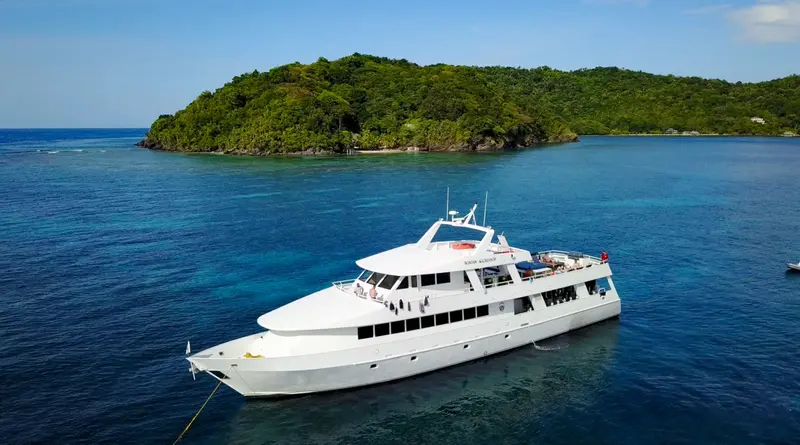
1 liveaboard departs from Roatan another way to explore the region, over several days at sea.
You can dive West End Wall from March to November. August is especially interesting because seasonal silverside aggregations arrive and attract larger predators. This period also offers the chance to experience the wall’s coral formations, deep caverns, overhangs, and varied marine life while exploring the site’s extensive drop-off.
West End Wall is best suited to Advanced Open Water certified divers because strong currents may occur and the wall reaches depths beyond recreational limits. Shallower sections are accessible to all levels. Profiles commonly begin around 6 metres, while the site extends from shallow coral gardens down to 90 metres.
You should expect a strong current running along West End Wall, so dives are typically conducted as drift dives. Visibility generally ranges from 24 to 30 metres, giving you broad views of the vertical wall, coral growth, caverns, overhangs, and the drop-off as the current carries you along.
At West End Wall, you can see Creole wrasse, reef fish, large schools of jacks, tarpon, sea turtles, barracudas, groupers, spiny lobsters, moray eels, spotted eagle rays, and southern stingrays. Coral gardens, gorgonians, caverns, overhangs, and seasonal silverside aggregations add variety along the wall.