
East End Dive Club
Google 5/5 (24 reviews)
3.1 km away as the crow flies
Roatan · Honduras · Americas
Max. depth · 110 mDescend onto the 91-meter cargo ship Odyssey, exploring its wheelhouse, collapsed cargo holds, and the marine life that has claimed its structure since its intentional sinking.
For subtitles in English: start the video firstthen click the gearat the top right of the video, select “Subtitles/CC”, then “Auto-translate” and choose “English”.
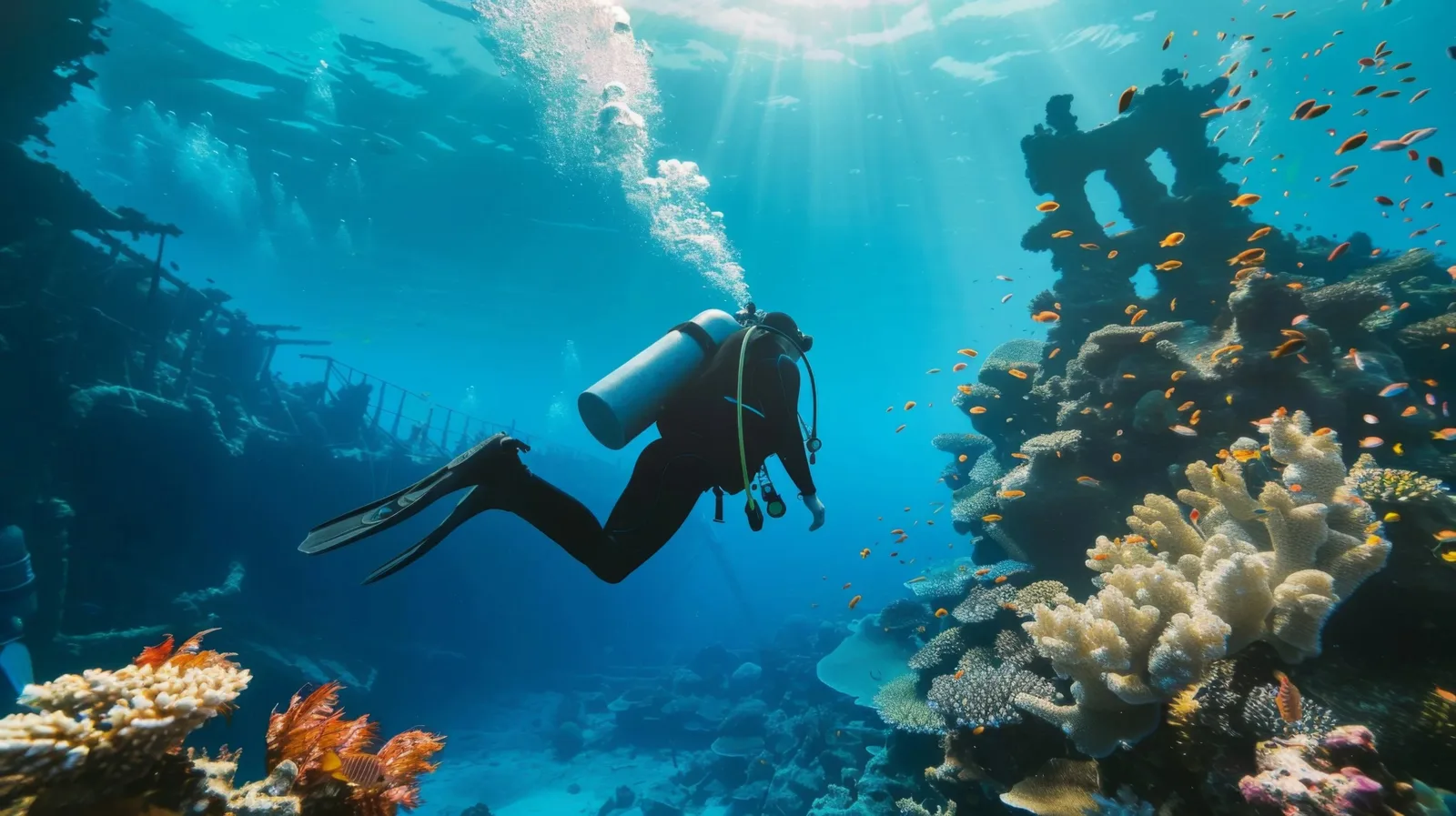
The Odyssey Shipwreck lies just off West End, Honduras, a 91-meter cargo ship resting on a sandy bottom, with its deepest section at 33 metres. Intentionally sunk in 2002 to create an artificial reef, the wreck is one of the largest in the Caribbean, having been cleaned and prepared extensively to ensure diver safety before its descent. You'll find the stern reaching up to 18 metres, presenting a substantial structure to begin your dive, while the central part lies flatter in the sand at 30 metres.
As you approach the Odyssey, you'll first encounter its sheer scale. Its overall length is 91 metres, with a width spanning 15 metres and a height of 26 metres from keel to deck. The ship lists to its starboard side, a detail that becomes evident as you navigate along its structure. The stern section, rising from the sand, offers an immediate visual impact, with marine stairs connecting its various levels—these are now home to a dense growth of hydroids.
Your descent will typically lead you towards the wheelhouse. This section is open for exploration, allowing you to venture inside and out, observing how marine life has integrated with the ship's operational components. The structural integrity of the wreck means that while some areas, like the central cargo section, have collapsed, other parts, such as the bow, remain upright, providing panoramic views that extend into the surrounding reef wall and sandy areas. Divers often report seeing large schools of barracuda (Sphyraena barracuda) and snapper (Lutjanidae) congregating around these structures.
The central part of the Odyssey, while partially collapsed, reveals a cargo area described as being the size of a football field. While extensive penetration requires specific wreck diving certification and appropriate lighting, pre-cut entry points allow for external observation and limited exploration for certified advanced divers. The immense size of the wreck means a full exploration in a single dive is not feasible, inviting multiple visits to uncover its different sections and resident species.
Moving away from the main structure, particularly towards the east into the sand, you might spot gardens of sand eels (Heterocongrinae), a common sight in the calmer, sandy areas surrounding large artificial structures. The wreck also hosts green moray eels (Gymnothorax funebris) tucked into crevices, encrusted Atlantic thorny oysters (Spondylus americanus), and groupers (Epinephelinae) that have made parts of the hull their home. Blue parrotfish (Scarus coeruleus) can also be seen grazing on the growth covering the wreck's surfaces.
The Odyssey's environment regularly attracts larger pelagic species. Schools of great barracuda (Sphyraena barracuda) are a common presence, often patrolling the upper sections and open water around the wreck. Divers have also reported sightings of tuna (Thunnini) and even sharks in the vicinity, although these encounters are less predictable. The substantial profile of the wreck serves as a beacon in the blue, drawing in a diverse cross-section of the local marine ecosystem.
The Odyssey Shipwreck is accessible from a minimum depth of 18 meters, with the deepest sections reaching 33 meters on the sandy bottom. This site requires Advanced Open Water certification due to its depth and the complexity of wreck diving; a dedicated wreck diving certification is recommended for internal penetration. Visibility typically ranges between 18 and 30 meters. While currents are generally mild, conditions can vary.
1 liveaboard departs from Roatan another way to explore the region, over several days at sea.
The Odyssey Shipwreck requires Advanced Open Water certification because of its depth and the complexity of wreck diving. A dedicated wreck diving certification is recommended if you plan to penetrate the interior. Certified advanced divers can use pre-cut entry points for external observation and limited exploration, while extensive penetration requires appropriate training and lighting.
The Odyssey Shipwreck ranges from 18 metres at the stern to 33 metres on the sandy bottom. The central section lies at about 30 metres, while the stern rises from the sand to 18 metres. Its depth makes this wreck suitable for advanced divers, with different sections offering varied underwater profiles.
Currents at The Odyssey Shipwreck are generally mild, although conditions can vary. Visibility typically ranges from 18 to 30 metres, allowing you to view the wreck’s large structure and surrounding sandy areas. The ship rests on a sandy bottom, with open water and reef wall views around parts of the site.
At The Odyssey Shipwreck, you can explore the wheelhouse inside and out, inspect the ship’s structures, and observe barracuda and snapper around the wreck. Green moray eels occupy crevices, while sand eels gather in nearby sandy areas. You may also see groupers, blue parrotfish, Atlantic thorny oysters, tuna, or sharks.