Liveaboards · Thailand
Thailand Aggressor — a spacious Andaman Sea dive yacht built around its crew and galley
Deal on this boat
Per person
£2,608$3,487€3,115 £1,956$2,615€2,336
Discount calculated by us, against the boat's usual price for a trip of the same length.
See all discounted dates ↓What makes this boat unique
- - The Thailand Aggressor takes up to 16 guests in eight air-conditioned staterooms.
- - Diving is organised around a shaded dive area, a platform and tenders for diver transfers.
- - Tanks accept both K and DIN valves, with nitrox available as an optional extra for certified divers.
- - The boat combines local and Western food, full-board meals, snacks throughout the day and wine with dinner.
- - English and Thai are spoken on board.
For subtitles in English: start the video firstthen click the gearat the top right of the video, select “Subtitles/CC”, then “Auto-translate” and choose “English”.
The invitation
The Thailand Aggressor suits divers who want a full Andaman Sea week without giving up the space to eat well, handle cameras and disappear between dives. The boat is designed for diving first, but the reasons to choose it are not limited to the platform: the crew scores strongly for the way it looks after a group, while the food is one of the boat's clearest strengths. A shaded dive area matters when equipment goes on and off repeatedly in tropical heat. A proper camera room and separate camera rinse keep a week of photography from turning every available surface into a workbench. The route returns to Panwa Pier after eight days and seven nights, giving the trip a clear shape rather than a short resort add-on. Choose this boat for the combination: a manageable guest count, a crew that remains visible through the day, and a galley capable of making the hours between dives feel like part of the trip.
Boarding
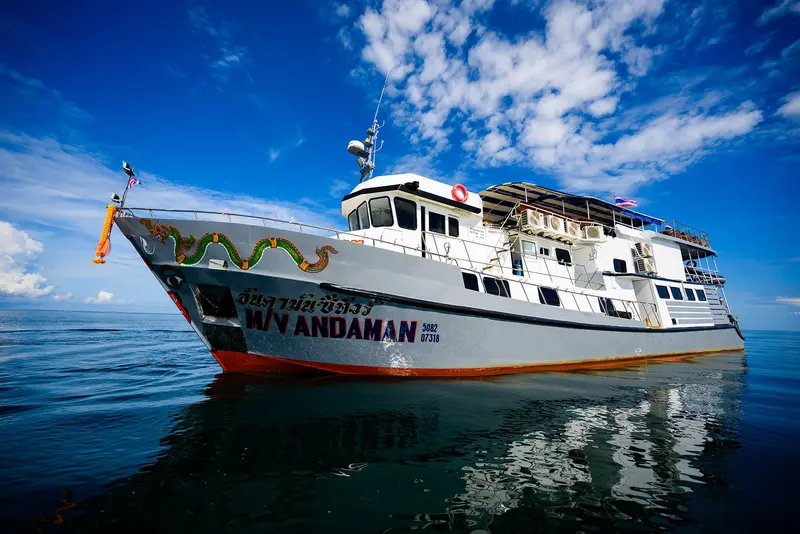
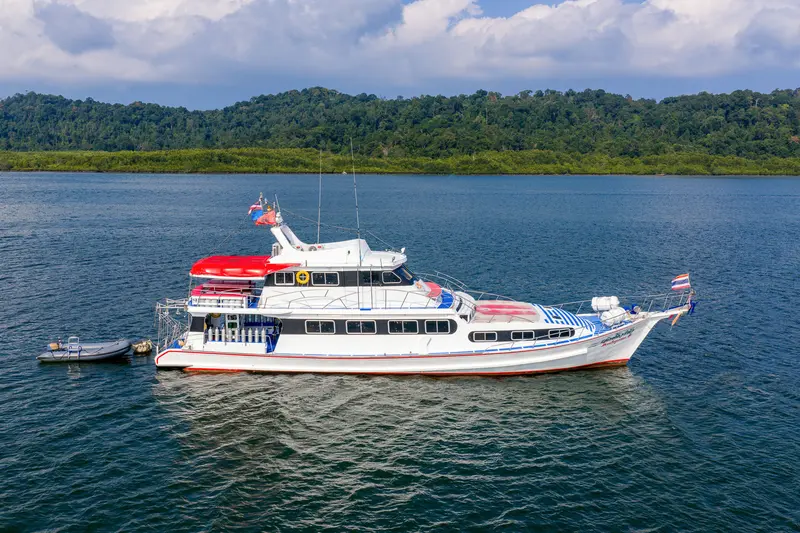
The first impression is of a proper dive yacht rather than a compact charter boat. There is room to move from the interior salon to the shaded outdoor areas, and the layout gives divers somewhere to sit without putting every conversation on top of the dive operation. The yacht runs on diesel power and moves at a steady cruising pace, so the boat is made for reaching the Andaman Sea rather than pretending to be a sailing vessel. Inside, the atmosphere is practical: air conditioning, private bathrooms and a salon for meals, briefings and evening films. Outside, the terrace, bar, grill and hot tub shift the focus from logistics to open air once the gear is put away. Nothing about the boat asks guests to live out of a narrow corridor. It is a vessel built to carry a small group through a week of repeated dives while keeping the common spaces usable.
The atmosphere on board
The boat's character comes from the crew's presence through the whole day. Twelve crew members support the operation, speaking English and Thai, with the dive team handling briefings and in-water assistance while the galley and service crew keep the rest of the boat moving. Guests are not left to decode the routine alone: every dive begins with a comprehensive briefing, and staff may be in the water to help with photography, videography or finding small life. That support is offered without turning the dive into a guided procession; divers are not required to follow the staff member underwater. Meals are another centre of the social life, and the strong food reputation is earned in the repeated details of a week: something ready after a dive, a table that works for a full group, and enough variety to keep dinner from feeling like another logistical stop. Evenings can hold fish identification, films, games or conversation.
Who puts you in the water
The dive team starts each descent with a full briefing, covering the site and the information needed before entering the water. When a dive is made directly from the yacht, at least one staff member may be in the water to offer support, spot critters and assist with underwater photography or video. On tender dives, a staff member accompanies each tender group and helps keep the group together. That does not mean staff are the diver's automatic buddy: dives remain buddy-team dives, normally in teams of two or three, and the in-water staff member does not directly supervise every diver. Advanced training and the Enriched Air Nitrox specialty may be arranged on board, depending on the instructor. The crew speaks English and Thai. Emergency equipment includes oxygen, first-aid kits, fire alarms and extinguishers, radios, GPS, radar, sonar, emergency beacons, rescue boats and life jackets, with crew trained in first aid.
The dive deck and the gear
The dive operation starts with 80-cubic-foot tanks filled with air. Thailand Aggressor accepts both K and DIN valves, so a DIN regulator can be used without bringing an adapter. Larger 100-cubic-foot or 15-litre tanks may be requested, but availability is not guaranteed and requests are handled first come, first served. Nitrox is available at 32% for certified nitrox divers as an optional extra; a nitrox course can also be taken on board, after which student fills are available. The shaded dive area, platform and tenders keep entries and exits separate from the lounge spaces. A dedicated camera room, charging stations and separate camera rinse are the important details for photographers, while a general equipment rinse and outdoor showers deal with the rest of the kit. Rental equipment and snorkeling equipment are available as optional extras. Rebreathers are not supported, and sidemount is accepted only with a single-cylinder configuration.
Between dives
Between dives, the shaded outdoor area is the natural place to settle with a drink, a book or a camera. The large sun deck adds chaise lounges and deck chairs when the weather calls for open sky, while the air-conditioned salon gives the group a cooler retreat. The hot tub, bar and grill belong to the hours when nobody needs to touch a regulator. A library, audio and video entertainment, and films in the cabins cover the quieter stretches without turning the boat into a resort programme. Divers travelling with cameras have a separate camera room, charging stations and a dedicated rinse area, so editing and drying equipment do not take over the living spaces. Non-divers and snorkelers are welcome, which makes the boat workable for a mixed group even though the day's centre of gravity remains below the surface.
A day on board
A day follows the needs of the diving rather than a sightseeing timetable. The first briefing comes before the first entry, then the boat moves through the cycle that liveaboard divers know well: dive, recover, eat, refill and prepare again. Breakfast and lunch sit around the diving, while snacks keep the shorter gaps from becoming a scramble for food. Between entries, the shaded dive area handles the practical work and the sun deck or air-conditioned salon handles the waiting. Camera divers can move from the water to a dedicated workspace instead of spreading equipment across the dining table. A later briefing brings the group back to the operation, and the evening can finish with a film, a fish-identification presentation, a game or a quiet drink at the bar. The exact number and timing of dives depend on the itinerary and conditions, but the boat is set up for repeated diving without making every surface interval feel like a transfer.
What you eat aboard
Meals are served as full board, with a buffet approach and snacks available throughout the day. Breakfast brings fresh fruit, hot dishes, cereals and juices; lunch moves through soup, bread, salad, sandwiches and hot entrées; dinner is prepared and served in the evening, with salad, vegetables, seafood, beef or chicken and a fresh dessert. The galley works across Western and local cuisine rather than locking the trip into one style, and vegetarian options are available. Non-alcoholic drinks, water, tea and coffee are included, with beer available and wine served at dinner. On a liveaboard, food has a job beyond filling the gap between dives. It gives divers a proper pause: somewhere to sit, talk through what was seen, and return to the next briefing fed rather than merely snacking over a gear bag.
Nights at sea
The cabins are air-conditioned and each has a private bathroom and shower, so the basic recovery after a dive does not depend on sharing facilities. Deluxe Stateroom Twins use twin beds; the Master Staterooms use a queen bed, with options on the main and lower decks. The lower-deck master has a portlight view, while the main-deck masters have picture windows; other cabins offer a picture window or porthole. That distinction matters at sea: a porthole gives the room daylight and a sense of connection to the water, while a picture window makes the outside part of the cabin rather than a small glimpse. Cabins also have individual air conditioning, storage, hair dryers, fresh towels and a television loaded with films. The useful luxury here is not decoration. It is being able to close the door, cool down and sleep in a private space after a demanding dive day.
Deluxe Stateroom Twins
Master Stateroom Main Deck
Master Stateroom Lower Deck
What to know before boarding
The South Andaman Sea itinerary departs from and returns to Panwa Pier in Thailand. An airport transfer is included; hotel transfers are optional. Guests should arrive in Thailand at least one night before boarding, rather than trying to make the pier immediately after a long international journey.
Deck plan
Itineraries, dates and prices
Prices per person. Each month shows its lowest price: click a month, or pick an itinerary.
Next departures · 81 departuresfrom £1,956$2,615€2,336
November 2026
December 2026
January 2027
March 2027
April 2027
Green dot: a discounted departure that month. Discount calculated by us, against the boat's usual price for a trip of the same length.
See dates and prices
If you click these links and make a purchase on the partner site, DivingDeal may earn a commission, at no extra cost to you.
Dates and prices taken from Divebooker and liveaboard.com, updated 26 October 2026
- Length
- 35.1 m
- Beam
- 7 m
- Maximum number of passengers
- 16
- Number of cabins
- 8
- Number of bathrooms
- 9
- Cruising speed
- 9 knots
- Website
- aggressor.com ↗
Hello, I'm Marina, DivingDeal.com's AI assistant. I answer in detail about hotels, dive centres and liveaboards.
Thinking about the whole trip and the flights? Talk it over with Edith →
Marina is an AI. Some links are affiliate links: DivingDeal may earn a commission, at no extra cost to you. Bookings are made with the partner.