
Reggae Dive Center
★ 4.9/5 (1,673 reviews)
18 km away as the crow flies
Coron · Philippines · Asia
Max. depth · 45 mExplore the impressive 147-meter Irako, a largely intact Japanese WWII refrigeration transport, offering deep wreck penetration and abundant marine life.
For subtitles in English: start the video firstthen click the gearat the top right of the video, select “Subtitles/CC”, then “Auto-translate” and choose “English”.
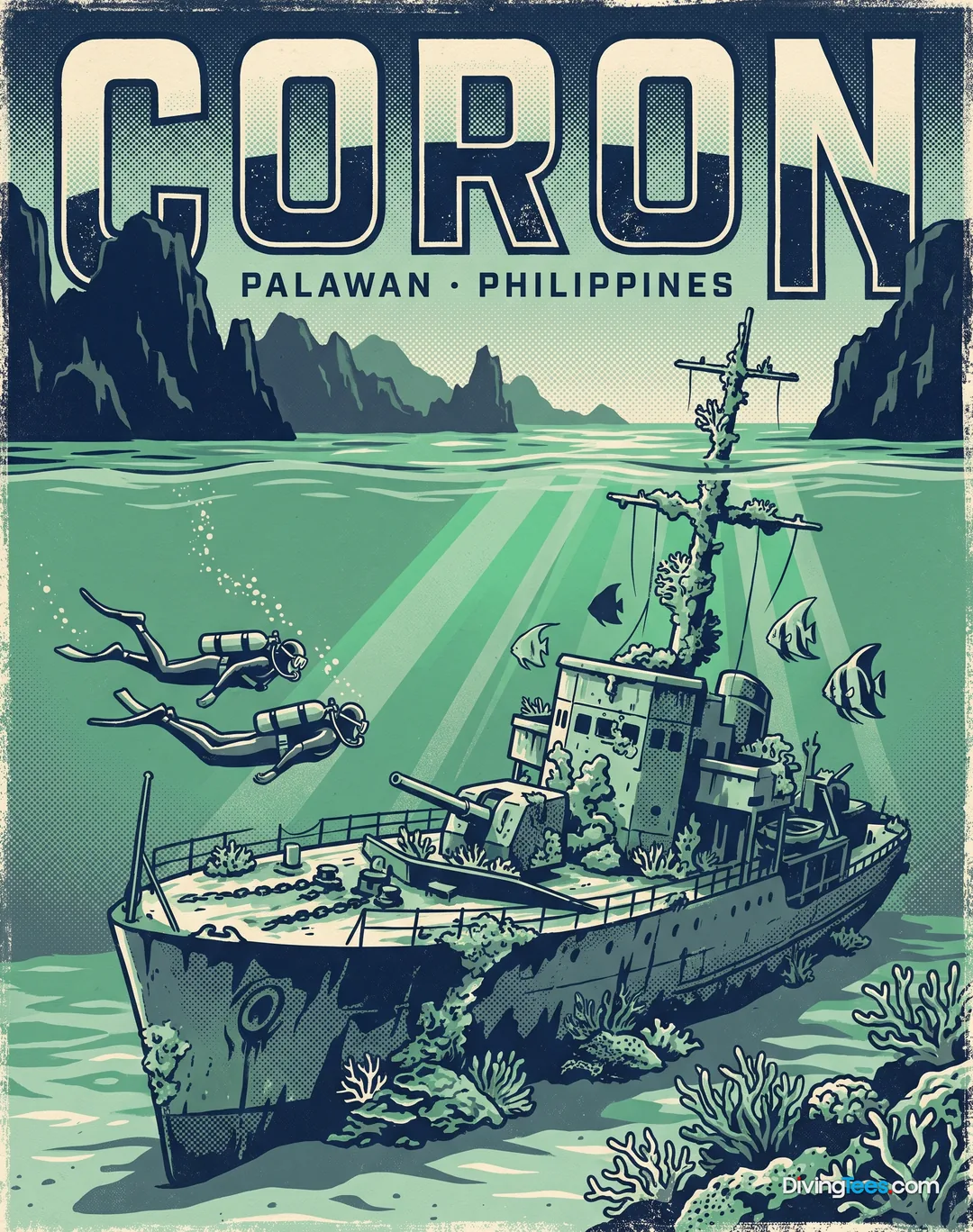
The Irako, a former Japanese refrigeration transport, lies vertically on the seabed of Palawan, its bow and stern clearly defined, stretching 147 meters in length. Built in 1937, this refrigerated provision vessel was designed to resupply multiple ships, capable of feeding 25,000 personnel for two weeks. Unlike many cargo ships, this vessel was designed for speed and armed for defensive combat, its anti-aircraft batteries responding fiercely during the attack that ultimately led to its sinking on September 24, 1944, during a U.S. air raid. It suffered multiple hits to its upper deck amidships before slowly sinking. Today, the main deck sits at approximately 30 metres, while the sandy bottom extends to 45 metres.
As you descend along the starboard side, the full scale of the Irako materializes from the blue. The wreck is largely intact, giving a clear sense of its original form. Even at the main deck level, the vastness of this ship is apparent, with large sections of superstructure still in place. The light diminishes noticeably below 30 metres, emphasizing the wreck's depth and the history it holds, setting the stage for a true deep wreck exploration. Approaching the Irako, you are reminded of its wartime role. Its structure, though damaged, still holds the proud lines of a naval vessel, built not just for transport but also for resilience. The site often sees clear water, allowing the entire silhouette of the wreck to emerge from the blue as you get closer.
Penetration opportunities exist into the wheelhouse and various holds, offering a chance to briefly explore the interior spaces used for fresh provisions. These entry points require good buoyancy and awareness of your surroundings inside the wreck. For those with extensive experience, the engine room provides a more demanding penetration, showcasing the machinery that once powered this substantial vessel. Always consider your gas management and dive profile when planning any entry into confined spaces. The exploration of its holds and engine rooms reveals the ship's complex design and its unique function as a refrigeration vessel. Penetrating the wreck requires appropriate training and equipment, as the interior is dark and can involve tight passages.
Even from the exterior, the scale of the Irako offers a wealth of details to observe, from the deck guns that once defended it to the damage inflicted by the battle. The impact zones are visible, a silent record of the ordnance that brought it down.
Around the wreck, a variety of marine life can be observed. Large groupers find shelter within its structure, while green sea turtles (Chelonia mydas) are often seen grazing or resting on the decks. Schools of barracuda (Sphyraena barracuda) and jackfish (Caranx ignobilis) patrol the wreck's perimeter, occasionally forming impressive tornadoes. Tuna (Thunnus spp.) are also known to pass by, drawn by the deeper water and schooling fish. Lionfish (Pterois miles), with their distinctive fins, are commonly seen perched on various parts of the wreck, often at shallower depths. These predators lie in wait for smaller prey, adding a splash of colour to the deeper, shadowed portions of the vessel. Keep an eye out for them, but remember their venomous spines and maintain a respectful distance. The surrounding environment is relatively open, ensuring that the wreck itself remains the undiluted focus of the dive. Each pass over the deck or along its hull offers new perspectives, inviting you to connect with a piece of history preserved by the sea.
This is a deep dive, with depths ranging from 30 metres at the main deck to a maximum of 45 metres at the seabed. You will need at least an Advanced Open Water certification, supplemented by a Deep Diver specialty, to safely access this site. A minimum of 50 logged dives with recent experience in deep environments is also strongly recommended. The wreck lies below 30 metres, requiring careful gas management and adherence to decompression protocols. Visibility here is generally good and can extend well, particularly outside the monsoon season. Current can sometimes be strong, particularly closer to the surface, during tidal shifts, or on the approaches, so plan your descent to meet the deck with control. Nitrox is highly recommended to extend your bottom time and manage nitrogen loading at these depths. The water temperature is generally warm, characteristic of the region, which makes the longer bottom times at this depth more comfortable, but thermal protection is always a consideration for deeper dives.
★★★★
★ 9.5/10 (303 reviews)
8.8 km away as the crow flies
★★★
★ 9.5/10 (254 reviews)
26 km away as the crow flies
★★★★
★ 9/10 (912 reviews)
17 km away as the crow flies
★★★
★ 9.3/10 (277 reviews)
3.3 km away as the crow flies
2 liveaboards depart from Coron another way to explore the region, over several days at sea.