Pufferfish
Tetraodontidae
It inflates like a balloon, carries enough venom to kill thirty people — and the Japanese have turned it into a gastronomic delicacy.
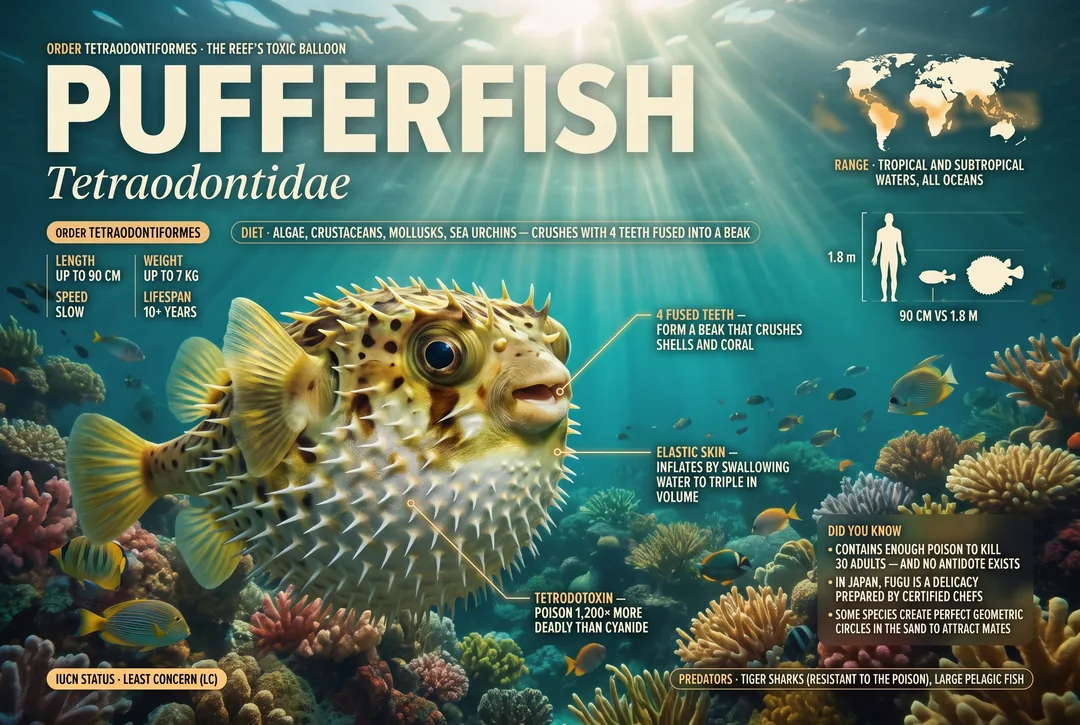
IDENTITY CARD
| Classification | Order Tetraodontiformes, family Tetraodontidae |
| Scientific name | Family Tetraodontidae (Bonaparte, 1831) — approximately 200 species |
| Size | From 3 cm (Carinotetraodon travancoricus) to 120 cm (Arothron stellatus), majority between 10 and 40 cm |
| Weight | From a few grams to 7 kg |
| Speed | Slow, manoeuvrable swimmer — propulsion via pectoral, dorsal, and anal fins |
| Lifespan | 4-10 years depending on species |
| Depth | 1 to 50 m, generally on shallow reefs |
| Diet | Omnivore — algae, sponges, crustaceans, molluscs, sea urchins, corals — powerful beak capable of crushing shells |
| IUCN Status | Variable by species — majority Least Concern (LC), some Vulnerable |
PORTRAIT
The pufferfish is an evolutionary paradox. A clumsy swimmer, slow, lacking protective scales and any capacity for rapid escape, it should be easy pickings for every predator on the reef. Instead, almost nothing eats it. Its secret: tetrodotoxin (TTX), a neurotoxin 1,200 times more potent than cyanide, concentrated in the liver, gonads, skin, and sometimes the muscles. A single medium-sized pufferfish carries enough TTX to kill 30 adult humans. There is no antidote.
Its second line of defence is mechanical. When threatened, the pufferfish gulps large quantities of water — or air if out of the water — and inflates into a spine-covered sphere, a ball too large and too prickly for most predators to swallow. The name Tetraodontidae means "four teeth," a reference to the beak formed by four fused dental plates, capable of crushing sea urchin shells, crab carapaces, and coral branches.
For divers, the pufferfish is a frequent and endearing encounter. Its large, expressive eyes, its bumbling, undulating swim, and its curiosity toward bubbles make it an irresistible photographic subject. It is common on every tropical reef in the world.
HOW TO RECOGNIZE IT
Pufferfish share a distinctive profile: a stocky, rounded body, a large head, big mobile eyes, and a small protruding beak. The skin is thick, often studded with tiny spines that stand erect during inflation. The fins are small and rounded — dorsal and anal fins set far back, with a fan-shaped caudal fin.
The most commonly encountered species on tropical reefs:
- Arothron hispidus (white-spotted puffer) — grey-brown with white spots, up to 50 cm, ubiquitous across the Indo-Pacific.
- Arothron meleagris — black with white spots or entirely yellow (xanthic phase), common in the Pacific.
- Arothron nigropunctatus (blackspotted puffer) — grey with black spots and thick lips, often described as "the most expressive" of the pufferfish.
- Canthigaster valentini — small (10 cm), striped black and white with orange spots, very commonly seen in pairs.
Behaviour is the most reliable giveaway: the pufferfish swims slowly, undulating its small fins, stops frequently to inspect the substrate, and faces the diver with a look of placid curiosity. Inflation is triggered only under intense stress — a respectful diver will never witness it.
For subtitles in English: start the video firstthen click the gearat the top right of the video, select “Subtitles/CC”, then “Auto-translate” and choose “English”.
WAY OF LIFE
The pufferfish is a reef grazer. Its beak, formed by four dental plates in continuous growth — much like a rodent's incisors — allows it to consume prey beyond the reach of most fish: sea urchins, shellfish, crabs, hard corals, and calcareous algae. This diet makes it a key player in the reef ecosystem, controlling urchin populations and sculpting the structure of the coral itself.
Tetrodotoxin is not produced by the fish itself. It is synthesised by symbiotic bacteria (Vibrio, Pseudomonas) that colonise certain organs. The fish accumulates the toxin throughout its life, primarily in the liver and ovaries. Juveniles reared in sterile conditions, free of bacteria, are not toxic at all — proof that the poison is acquired, not innate.
Reproduction varies among species. In Arothron, the male courts the female by swimming in circles around her and nudging her toward the surface. Eggs are deposited on the substrate and sometimes guarded by the male. Certain freshwater pufferfish species build elaborate nests in the sand — spectacular circular geometric patterns discovered in 2012 off the coast of Japan and attributed to Torquigener albomaculosus.
Inflation is a last-resort mechanism. The fish rapidly swallows water using a specialised buccal pump, doubling or tripling its volume in a matter of seconds. The effort is considerable and stressful for the animal — provoking inflation by touching or harassing a pufferfish is an irresponsible practice that can injure it.
WHERE TO SEE IT
The pufferfish inhabits every tropical and subtropical reef on earth. It is one of the easiest fish to find and observe — it does not flee, it swims slowly, and it often lingers in shallow water.
Red Sea — Egypt. The reefs of the Red Sea harbour several spectacular species, including Arothron stellatus (the largest, up to 120 cm) and the diminutive Canthigaster genus. Sites around Dahab, Marsa Alam, and Ras Mohammed offer frequent sightings in the shallow coral gardens.
Indonesia — Bali, Komodo, Raja Ampat. The Coral Triangle holds the greatest diversity of pufferfish on the planet. The muck diving sites of Bali (Tulamben, Amed) are particularly productive for uncommon species.
Maldives. Arothron nigropunctatus is omnipresent on the thilas and drop-offs of the Maldivian atolls. Its round silhouette and resigned expression have become an underwater photography classic in the Maldives.
Japan — Amami-Oshima. The site where the "mystery circles" of Torquigener were first discovered — sand structures measuring 2 m in diameter, crafted by a pufferfish just 12 cm long. Observable from March to July, at depths between 15 and 30 m.
Caribbean — Bonaire, Curacao, Belize. Atlantic species (Sphoeroides, Diodon) differ from their Indo-Pacific cousins but are equally photogenic. The porcupinefish (Diodon hystrix), a close relative, is a common sight tucked inside reef crevices.
OBSERVATION CALENDAR
| Destination | J | F | M | A | M | J | J | A | S | O | N | D |
|---|---|---|---|---|---|---|---|---|---|---|---|---|
| Red Sea (Egypt) | ||||||||||||
| Indonesia (Bali) | ||||||||||||
| Maldives | ||||||||||||
| Japan (Amami-Oshima) | ||||||||||||
| Caribbean (Bonaire) |
Click each button to show/hide
CONSERVATION
Most pufferfish species are classified as Least Concern (LC) by the IUCN. Their toxicity shields them from the majority of natural predators and from commercial fishing — few people want to eat a fish that carries enough poison to kill thirty of them.
The notable exception is Japanese fugu. Preparing fugu (Takifugu rubripes and related species) is a codified culinary art that requires a special licence — only chefs certified after years of training may prepare it. Despite these precautions, fugu still kills a handful of people in Japan each year. Demand has driven intensive farming and localised overfishing of certain species.
Indirect threats mirror those facing all reef fauna: coral reef degradation, bleaching, plastic pollution, and ocean acidification. Pufferfish that depend on specific habitats — seagrass beds, shallow coral reefs — are the most vulnerable.
Organizations to support:
- Coral Reef Alliance (CORAL) — coral reef protection
- Reef Check — citizen-led reef health monitoring
- PADI AWARE — participatory marine conservation
- Ocean Conservancy — combating ocean pollution
3 THINGS YOU PROBABLY DON'T KNOW
1. A pufferfish builds sand cathedrals. In 2012, Japanese divers discovered geometrically perfect circles measuring 2 m across, etched into the sand at 25 m depth off Amami-Oshima. The architect: Torquigener albomaculosus, a pufferfish just 12 cm long. The male works day and night for a week, sculpting radial ridges with its fins, to attract a mate. The structure channels the current and concentrates fine sediment at the centre — exactly where the eggs will be laid. It is the most elaborate construction ever documented in a fish.
2. Its poison is 1,200 times more potent than cyanide — and it does not produce it. Tetrodotoxin (TTX) is a neurotoxin that blocks the sodium channels of nerve cells, causing progressive paralysis and death by respiratory failure. A single milligram is enough to kill an adult. But the pufferfish does not synthesise it: the toxin is produced by symbiotic bacteria living in its organs. Pufferfish raised without these bacteria are completely harmless.
3. Fugu is a 200-euro dish — and a wager on your life. In Japan, fugu is a luxury delicacy served in paper-thin translucent slices (tessa). Only chefs who hold a special licence — earned after three years of training and an exam with a 30% failure rate — may prepare it. The liver, the most toxic organ and regarded by some as the most flavourful, has been banned from sale since 1975. Even so, fugu still causes 20 to 40 poisonings per year in Japan, 1 to 3 of them fatal — almost invariably from amateur preparations.
PHOTO AND VIDEO TIPS
The pufferfish is an ideal subject for the novice underwater photographer: slow, cooperative, expressive, and common.
Lens. Macro (60-100 mm) for tight portraits — the large eyes and beak form a remarkably expressive "face." Wide angle for the larger species (Arothron stellatus in the Red Sea) framed within their reef surroundings.
The eyes. Everything hinges on the gaze. The pufferfish has mobile, expressive eyes with a coloured iris — blue, green, or gold depending on the species. The head-on portrait, both eyes visible and the beak slightly parted, is the signature shot. Wait for the animal to pause and turn its head toward the lens — its natural curiosity will draw it to face you.
Lighting. Moderate side-mounted flash. The pufferfish's thick, textured skin responds beautifully to raking light, which brings out the tiny spines and colour patterns. Avoid direct frontal flash, which flattens the volume.
Never provoke inflation. This is the absolute rule. Touching, pushing, or stressing a pufferfish to make it inflate is an irresponsible practice — the physiological effort is considerable and can injure the animal. The best photographs show the fish in its natural state, relaxed, grazing along the reef.