CMAS
Taha'a Diving
Google 4.7/5 (30 reviews)
Tahaa · French Polynesia · Pacific
Max. depth · 30 mDescend into Passe de Miri to explore three coral-covered rock formations where whitetip sharks patrol before drifting along a vibrant purple Distillopora wall.
Your dive at Passe de Miri, also referred to as 'les Trois Roches', begins with a descent towards three distinct rock formations. These large blocks are heavily encrusted with a diverse array of corals, creating a rich habitat. They serve as natural focal points, drawing in marine life and establishing a clear starting point for the dive. Around these structures, you'll frequently observe whitetip reef sharks (Triaenodon obesus) circling with a characteristic curiosity, making these initial moments a dynamic introduction to the site.
Beyond these initial rock sentinels, the dive transitions into an exploration of a striking coral wall. This drop-off is particularly known for its extensive growth of purple Distillopora coral, which forms a vibrant cascade of colour down the reef face. The intricate patterns of the coral reflect the abundant light, drawing your attention to the detailed structure of the reef and the delicate ecosystems thriving within its branches. This section offers a continuous visual spectacle, defined by the health and density of the coral formations.
Amidst this rich coral tapestry, you'll encounter a variety of reef fish that bring the wall to life. Emperor angelfish (Pomacanthus imperator) and regal angelfish (Pygoplites diacanthus) move gracefully through the coral branches, their vibrant patterns providing a contrast to the deep purple hues of the Distillopora. While the primary draw here is the coral itself, these resident angelfish add a dynamic element, showcasing the biodiversity that thrives in this particular Tahaa pass and offering consistent photographic opportunities.
The topography of the site, situated in the Miri Miri pass off the west coast of Raiatea, is characterized by these three large coral-covered rocks on the outer slope, leading into the vibrant coral wall. The pass itself is known for drift dives, and while the general area can experience significant current, the specific zone around 'les Trois Roches' often presents calmer conditions, allowing for a more focused exploration of the reef and its coral structures. This relative shelter, combined with the rich coral growth, makes it a distinctive dive within the broader pass.
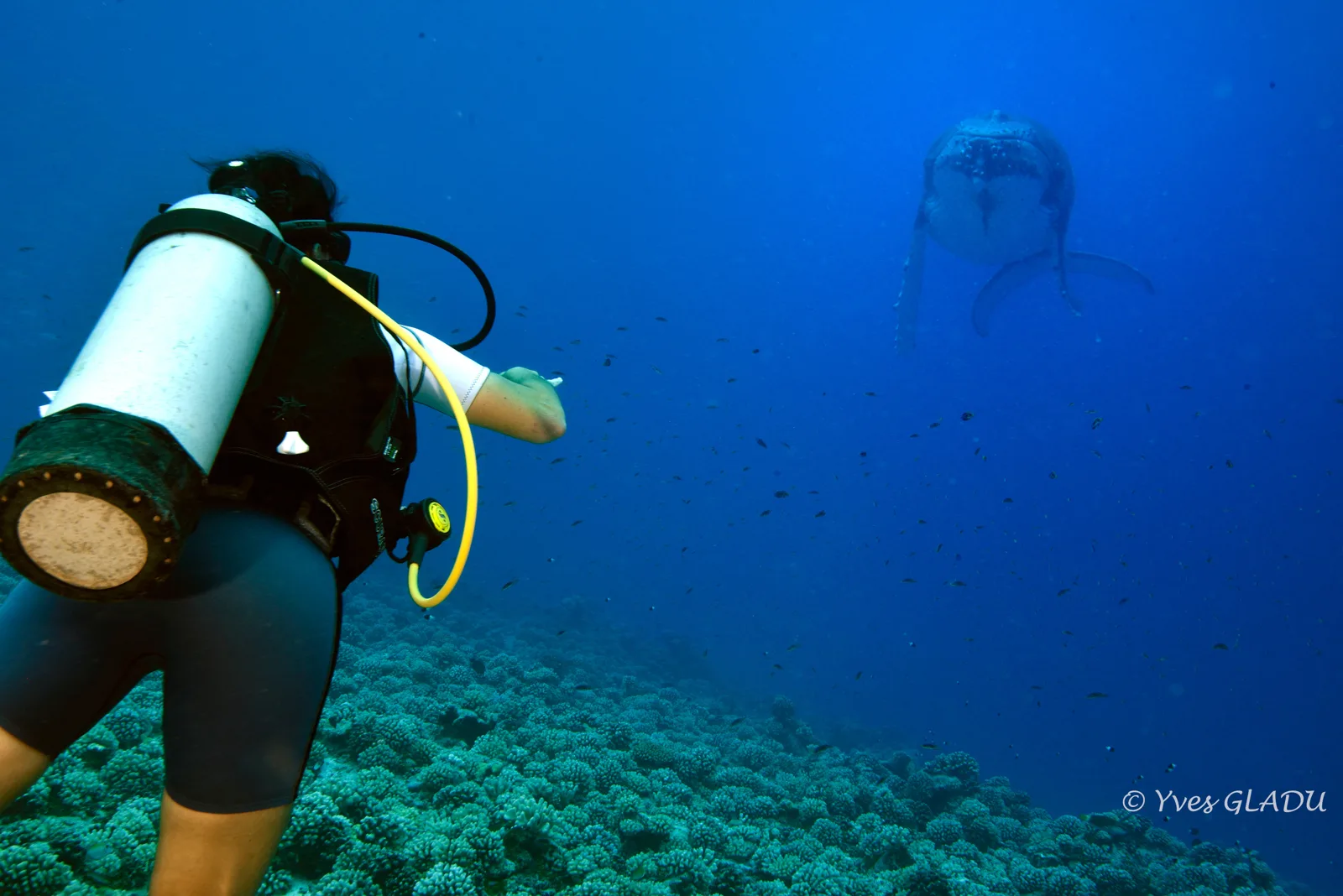
While the coral landscape provides a consistent spectacle, Passe de Miri often holds pleasant surprises that can elevate the dive beyond expectation. These moments might include fleeting glimpses of larger pelagic species passing through the current at the edge of the pass. Even on dives primarily focused on the macro details within the coral, the open water always offers the possibility of unexpected interactions, reminding you of the greater oceanic environment that surrounds this vibrant reef system.
Beyond the angelfish and whitetip reef sharks, the site's fauna includes barracuda, trevally, and batfish, which often school in the currents or patrol the reef edges. Leopard rays can also be seen gliding along the sandy patches or near the base of the wall. Blacktip reef sharks are occasionally present, adding to the diversity of shark encounters, while parrotfish and schools of paddlefin sea perch contribute to the constant activity on the reef.
The pass itself, Miri Miri, is sheltered from prevailing winds and swell, contributing to generally good diving conditions. While the drift can be noticeable, particularly during tidal changes, the specific area of 'les Trois Roches' allows for a more controlled exploration of the wall and its unique yellow Stylaster corals that punctuate the purple Distillopora. This combination of sheltered conditions and rich coral growth makes it a site where both the macro and the wider reef environment can be appreciated.
This site is accessible to divers holding a PE40 or Advanced Open Water certification, or an equivalent. The dive depth ranges from 0 to 30 metres. Current in the Miri Miri pass can be variable, with drift dives being common, but the specific area of 'les Trois Roches' often experiences calmer conditions. Visibility typically ranges between 20 and 30 metres.
You need a PE40 or Advanced Open Water certification, or an equivalent qualification, to dive Les trois roches. The site begins around three coral-covered rock formations and continues along a coral wall, so your training should match the stated certification requirement for exploring this Tahaa dive site.
Les trois roches ranges from zero to thirty metres deep. Your dive begins with a descent toward three distinct coral-covered rock formations, then continues toward a wall covered with purple Distillopora and yellow Stylaster corals. This depth range allows exploration from shallow areas down along the reef face.
At Les trois roches, conditions are often calmer than elsewhere in the Miri Miri pass, allowing more controlled exploration of the wall and rocks. The pass can have variable, noticeable current, especially during tidal changes, and drift dives are common. It is sheltered from prevailing winds and swell.
At Les trois roches, you can see three large coral-covered rocks, a purple Distillopora wall, yellow Stylaster corals, and whitetip reef sharks. Emperor and regal angelfish move through the reef, while barracuda, trevally, batfish, parrotfish, and paddlefin sea perch may appear. Leopard rays and blacktip reef sharks are also possible.