

Roatan Divers
Google 5/5 (408 reviews)
5.1 km away as the crow flies
Roatan · Honduras · Americas
Max. depth · 30 mBegin your dive at Bear's Den by dropping into a spacious swim-through that leads directly to a dramatic wall, where light interaction within a cavern creates unique photographic opportunities.
For subtitles in English: start the video firstthen click the gearat the top right of the video, select “Subtitles/CC”, then “Auto-translate” and choose “English”.
Bear's Den offers a dive profile that begins almost immediately with a spacious swim-through, just below where the mooring line attaches. This passage acts as your direct route to the main wall of the site. As you navigate through, you'll feel the gentle flow that guides you towards the reef's edge. The entry to this swim-through is at approximately 40 feet (12 metres), opening up an immediate exploration of the site's unique structure.
Exiting the swim-through at roughly 60 feet (18 metres), you find yourself at the top of a sheer wall that drops considerably deeper. Turning east from this point, the wall continues its descent to over 100 feet (30 metres) before meeting a sandy bottom. Along this section, you'll encounter a large coral outcropping at 80 feet (24 metres), adorned with Leaf Coral, forming a natural habitat for various reef residents.
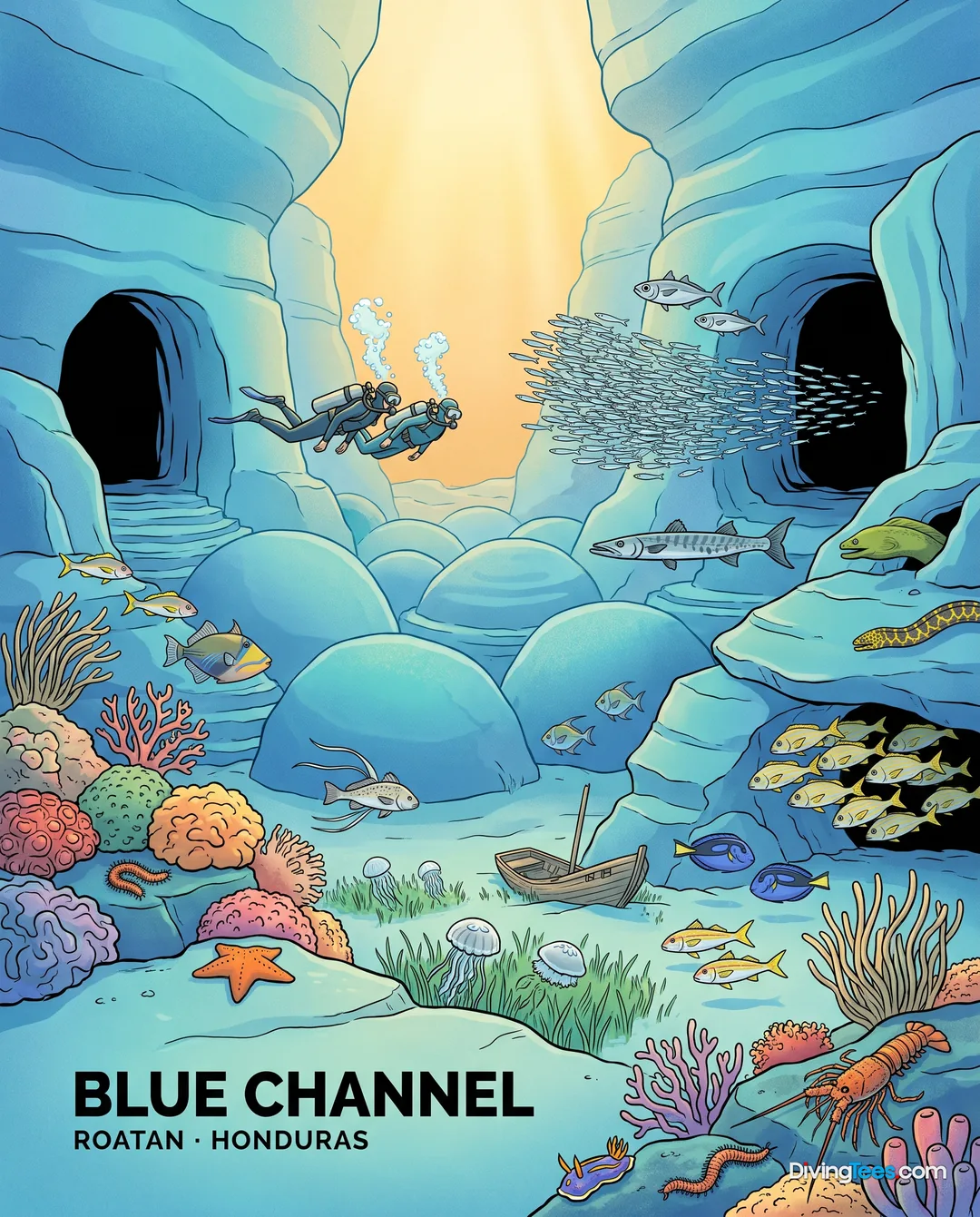
One of the defining features of Bear's Den is the cavern from which it derives its name. This chamber typically has a narrow entrance, but inside it opens up into a spacious environment, making it suitable for divers transitioning into overhead environments. Glassy Sweepers often congregate here, illuminated by the sun's rays filtering from above, creating a dynamic light show that's a highlight of the dive.
Beyond the main cavern, the shallow areas of this site extend with a variety of smaller caverns and crevices. These recesses provide shelter and hunting grounds for smaller marine life, including young Glassy Sweepers and Crabs. The interaction of natural light through these overhead structures offers striking moments, particularly engaging for those with an eye for underwater photography.
Moving west from the mooring, the topography shifts to a more open layout at around 50 feet (15 metres). Here, you'll find sandy patches interspersed with coral colonies, providing a different ecological zone to explore. Keep an eye out among these corals for species like Trumpetfish and various small fish that seek refuge in the intricate structures, adding to the site's biodiversity.
The site also provides opportunities for macro enthusiasts. Look closely at the soft corals near the top of the main wall, where Neck Crabs are commonly found. Lettuce Sea Slugs and juvenile Drum Fish also make appearances, often nestled within the reef's crevices. These smaller details contribute to the richness of the dive, rewarding a slow and observant approach.
While the focus is often on the dramatic wall and caverns, the coral formations throughout Bear's Den are integral to supporting the resident marine life. Elkhorn corals, especially in the shallower sections, provide extensive shelter and feeding grounds. This intricate coral architecture fosters a vibrant ecosystem, from the smallest crustaceans to the schooling fish that move through the passages.
Bear's Den is accessible from an intermediate diver level, specifically for Open Water Divers with some experience or those with an Advanced Open Water certification. The dive depth ranges from a minimum of 4.5 metres in the shallower cavern sections to a maximum of 30 metres along the deeper wall. Visibility is generally good, often ranging from 12 to 30 metres, which is typical for the region. Currents are usually mild, but as with any wall dive, conditions can occasionally shift, so maintaining good buoyancy control is always essential. The site can be dived year-round, with the dry season from February to September offering consistently calmer waters and better visibility due to less rainfall.
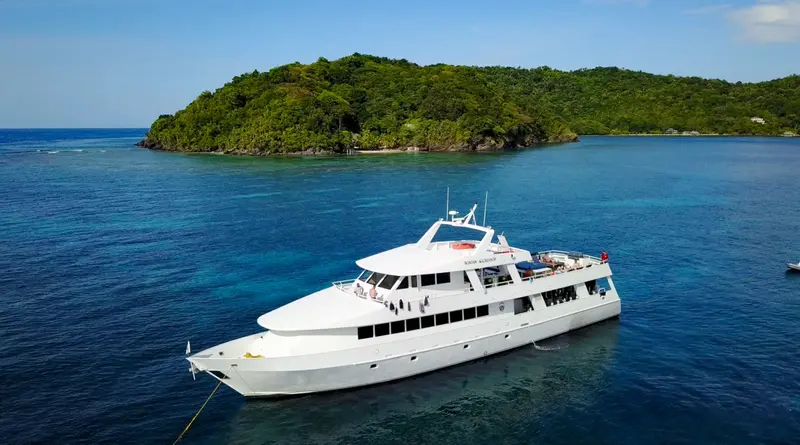
1 liveaboard departs from Roatan another way to explore the region, over several days at sea.
You can dive Bear's Den year-round. From February to September, the dry season generally brings calmer waters and better visibility because there is less rainfall. Visibility is often between 12 and 30 metres, giving you favorable conditions for exploring the swim-through, cavern, wall, coral formations, and smaller reef spaces.
Bear's Den is suited to intermediate divers. You should be an Open Water Diver with some experience or hold an Advanced Open Water certification. The site includes a swim-through, caverns, and a wall, while the Bear's Den cavern can suit divers transitioning into overhead environments. Good buoyancy control remains important throughout.
Bear's Den ranges from 4.5 metres in the shallower cavern sections to 30 metres along the deeper wall. Currents are usually mild, although conditions can occasionally shift on this wall dive. You should maintain good buoyancy control as you move through the swim-through, cavern, reef, and deeper wall areas.
At Bear's Den, you can explore a spacious swim-through, sunlit caverns with Glassy Sweepers, and a wall with coral formations descending to 30 metres. You may find Leaf Coral at 24 metres, Elkhorn corals in shallower areas, Trumpetfish, Neck Crabs, Lettuce Sea Slugs, and juvenile Drum Fish.