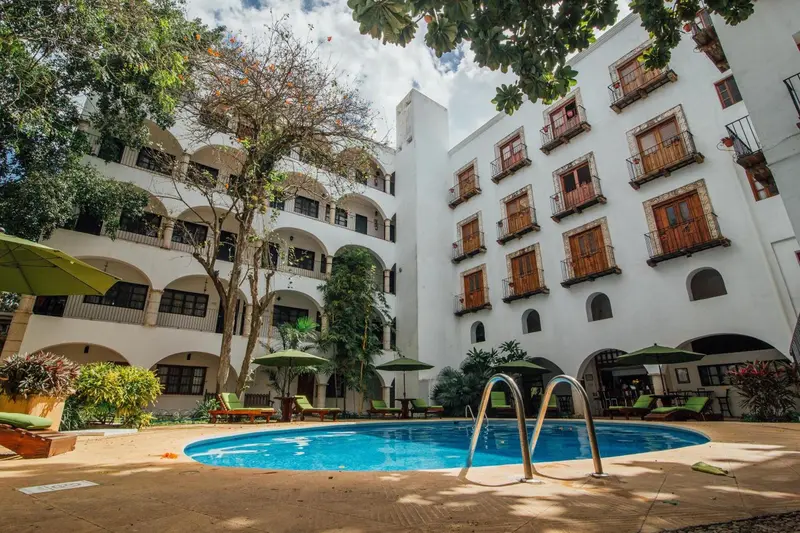
Hotel Meson del Marques
★★★★★
Google 4.4/5 (2,495 reviews)
Mexico · Americas
Limestone formations, light-filled cavern passages and dark cave routes make Valladolid a cultural Yucatán base for guided cenote diving by road.
For subtitles in English: start the video firstthen click the gearat the top right of the video, select “Subtitles/CC”, then “Auto-translate” and choose “English”.
Valladolid is a place to add cenote diving to a Yucatán journey, not a substitute for a coastal marine base. The town gives access by road to freshwater caverns and cave systems, where limestone formations replace reefs and the guide, route and qualification matter as much as the water itself. Between dives, colonial streets, markets, bathing cenotes and Maya sites give non-divers plenty to do. Allow two to four days for a sensible combination of diving and culture.
Underwater, Valladolid means overhead environments rather than open water. In a cavern, the route remains within natural daylight, with limestone formations, confined passages and the distinctive light of a cenote. Beyond that illuminated zone, the dive becomes cave diving, with no direct surface exit and a much greater dependence on training, procedures and the guide’s route knowledge. Currents are not the defining issue here, and there is no downcurrent or drift dive to plan around. Visibility can be excellent in enclosed cenotes, but it is not uniform: rain, water entering the system, visitor pressure and the character of the individual site all matter. These are organised, road-based outings, not shore dives where you arrive and choose a route. A lamp, careful buoyancy and disciplined movement are part of the practical reality, even on a cavern dive.
Do not come to Valladolid expecting a cast of reef fish or a wildlife-led dive. The underwater encounter is primarily geological: pale limestone surfaces, constricted galleries, freshwater darkness and the boundary between daylight and cave. The visual interest lies in how the formations frame the route and how the water changes as the passage closes over. Cenotes also differ from one another, so the character of a dive depends on the site selected rather than on a standard local fauna list. There is no useful seasonal wildlife calendar to build the trip around. Choose Valladolid for the combination of cenote geology and Yucatán culture, then treat any small aquatic life encountered as incidental rather than the reason for travelling.
Valladolid has no single best diving season that applies neatly to every cenote. Conditions can change with rain, water entering the system, visitor numbers and the individual site, so the rainy season deserves particular attention when planning a route. The most practical advantage comes from timing rather than chasing a named month: leave early for the quieter start and better access at popular bathing sites, while recognising that central hours bring more groups. Ask for current site conditions before committing to a particular cenote, especially after wet weather. A flexible plan works better than treating every day of the year as identical.
A properly supervised cavern dive may suit an experienced Open Water diver, including those qualified through BSAC, PADI or SSI, provided the route stays within natural light and the diver has recent confined-environment experience. That qualification does not authorise entry into dark galleries. Any route beyond the daylight zone requires Cave Diver training or an equivalent qualification, plus specific cenote preparation and appropriate recent experience. Independent diving is not accepted in the guided cenotes, whatever the certification card says.
From London Heathrow, Gatwick or Manchester, Valladolid is reached by continuing overland from Cancún, Mérida, Playa del Carmen or Tulum. The town has no commercial airport, ferry or single harbour from which diving departures operate, so the road leg is part of the journey rather than an afterthought. Cenotes are dispersed, and each outing normally involves a planned transfer to the chosen site. Once in Valladolid, a compact central hotel may put meeting points within walking distance, but the cenotes themselves require an organised road transfer or taxi. Allow time between sites, as a route that looks simple on a map may involve separate drives rather than one convenient diving circuit.
Book the cenote and the guide before travelling, then confirm that the chosen site actually accepts scuba divers. Several nearby cenotes are for swimming or visiting, not bottle diving. Ask one precise question: is the plan a cavern dive in the daylight zone, or a cave dive beyond it? An Open Water card is not enough for the latter, and a swimmer’s rope or site marker is not a cave procedure. Do not plan independent exploration. Leave early for sites that attract bathing groups, and allow proper road time rather than stacking distant cenotes into one day. Bring a suitable lamp and check thermal protection with the guide, because equipment requirements vary by site. Before entering, follow the local water-protection rules: shower first and remove sunscreen, repellent, oils, make-up and hair products where required. Keep a day free before flying, so overhead-environment diving and the onward journey are not squeezed together.
Use Valladolid as a land-based stop, with diving woven around the town rather than the other way round. A typical stay combines a cenote outing with a day for colonial architecture, markets or Maya archaeology, leaving time for road transfers and an unhurried surface interval. Non-divers can visit bathing cenotes, villages and cultural sites while a guided dive is under way. Two to four days suits this balance; longer stays make more sense as part of a wider Yucatán itinerary.
Hello, I'm Marina, DivingDeal.com's AI assistant. I guide you through destinations, areas and countries.
Thinking about the whole trip and the flights? Talk it over with Edith →
Marina is an AI. Some links are affiliate links: DivingDeal may earn a commission, at no extra cost to you. Bookings are made with the partner.
Valladolid has no single diving season that suits every cenote. Rain can change conditions, along with water entering the system, visitor numbers and the individual site. Ask about current conditions before choosing a route, particularly after wet weather. Leave early for quieter access at popular bathing cenotes, and keep your itinerary flexible.
A supervised cavern dive in the natural-light zone may suit an experienced Open Water diver with recent confined-environment experience. Entering dark galleries requires Cave Diver training or equivalent qualifications, specific cenote preparation and appropriate recent experience. Independent diving is not accepted, so your certification and the planned route must match the guide’s arrangements.
Valladolid offers geological rather than reef or wildlife-focused diving. You can see pale limestone formations, confined freshwater galleries, light-filled cavern passages and increasing darkness as a route closes over. Cenotes differ from one another, so the character of each dive depends on the selected site. Any small aquatic life is incidental.
Book the cenote and guide before travelling, and confirm that the selected site accepts scuba divers. Plan organised road transfers because cenotes are dispersed, leaving time between sites. A stay can combine guided diving with colonial streets, markets, bathing cenotes and Maya archaeological sites. Shower before entry and follow local water-protection rules.