
Big Blue Diving, Koh Tao
★ 5/5 (5,415 reviews)
1.7 km away as the crow flies
Koh Tao · Thailand · Asia
Max. depth · 31 mExplore the HTMS Sattakut, a 48-meter WWII-era warship intentionally sunk to create a thriving artificial reef teeming with marine life and offering unique wreck penetration opportunities.
For subtitles in English: start the video firstthen click the gearat the top right of the video, select “Subtitles/CC”, then “Auto-translate” and choose “English”.
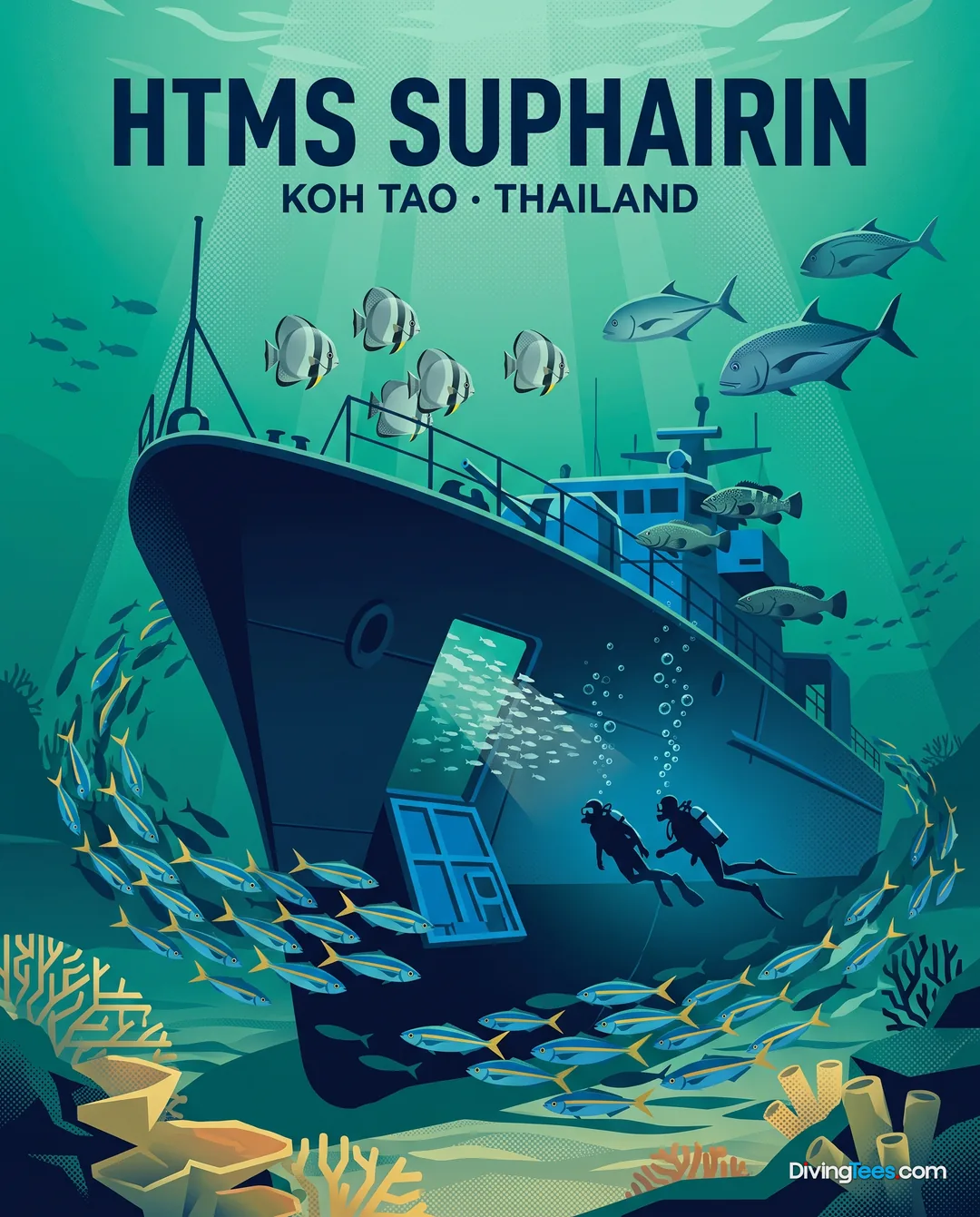
The HTMS Sattakut, a 48-meter former US Navy warship that served in WWII's Pacific campaigns and later with the Royal Thai Navy, now rests as an artificial reef off Koh Tao, just south of White Rock. Intentionally sunk in 2011, this 50-meter vessel lies upright on a sandy bottom, its bow facing north-west, providing a prominent dive site with a clear profile of the vessel. The ship's history adds a unique dimension to its current role as a habitat.
Your descent places you directly above the wreck, with its upper structures accessible from near the surface, extending down to a maximum depth of 31 meters. The upright positioning allows for straightforward navigation and observation of its entire length. The wreck's integrity, even after settling, provides a robust framework that has allowed marine life to flourish across its surfaces. The intact mast reaches towards the surface, and the main deck is now heavily encrusted with soft corals, attracting a variety of marine life.
As you explore the exterior, you will notice two anti-aircraft gun turrets, one at the bow and one at the stern, largely intact. These serve as tangible links to the ship's past and now provide shelter and vantage points for various inhabitants. The hull itself has become a substrate for a developing coral ecosystem, adorned with sponges and soft corals, inviting closer inspection. The vibrant soft corals are a primary attraction, growing in luxuriant patches across the former warship's surfaces. The light filtering through the water column plays across the metal hulk, highlighting the textures and colours of the growing coral.
The Sattakut teems with resident fish. You will encounter large groupers, snappers, and sweetlips patrolling the deck and around the superstructures. Schools of fusiliers, batfish, and jackfish move in unison, creating dynamic displays around the wreck. Barracudas, including giant barracudas, are common patrols around the wreck's perimeter, often hovering just off the structure. Moray eels, such as the white-eyed moray, are often found tucked into crevices throughout the wreck. The artificial reef structure encourages a higher density of fish compared to natural reefs, providing a teeming and active environment for observation. Keep an eye out for Jenkins' whiprays resting on the sandy bottom adjacent to the wreck or cruising nearby.
The presence of a large structure like the HTMS Sattakut in open water acts as a focal point, drawing in larger marine life that uses the wreck for hunting or as a navigational landmark, including pelagic species that patrol its perimeter. The wreck is located near the natural reef of Hin Pee Wee.
For those with appropriate training and experience, the HTMS Sattakut offers multiple penetration routes, transforming the dive into a technical exploration. These interior spaces, once the ship's operational areas, now provide unique overhead environment opportunities, from corridors to larger cargo holds, demanding excellent buoyancy control and navigation skills for safe passage.
The HTMS Sattakut is primarily a site for experienced divers due to its depth profile, extending to a maximum of 31 meters. An Advanced Open Water Diver certification is recommended for thorough exploration and to fully appreciate and safely navigate the wreck. While Open Water divers may explore the shallower external sections, specific wreck diving certifications are required for internal penetration. Current at the site can range from mild to strong, varying unpredictably, therefore always exercise caution and plan thoroughly. Conditions in the region can vary from weak to moderate, affecting visibility and pelagic activity. Visibility typically ranges from 3 to 30 meters, influenced by seasonal changes, creating variable conditions. The best periods for diving are generally from March to October and the dry season from March to September, when sea conditions are calmer.