Les 12 De Larros
★ 9.4/10 (738 reviews)
4.2 km away as the crow flies
Dive centre · Bassin d'Arcachon · France
4.841 Google reviewsExplore the deep Atlantic wrecks of the Bay of Biscay aboard the Dervinis 800 Pro, a dedicated aluminium vessel built for technical diving.
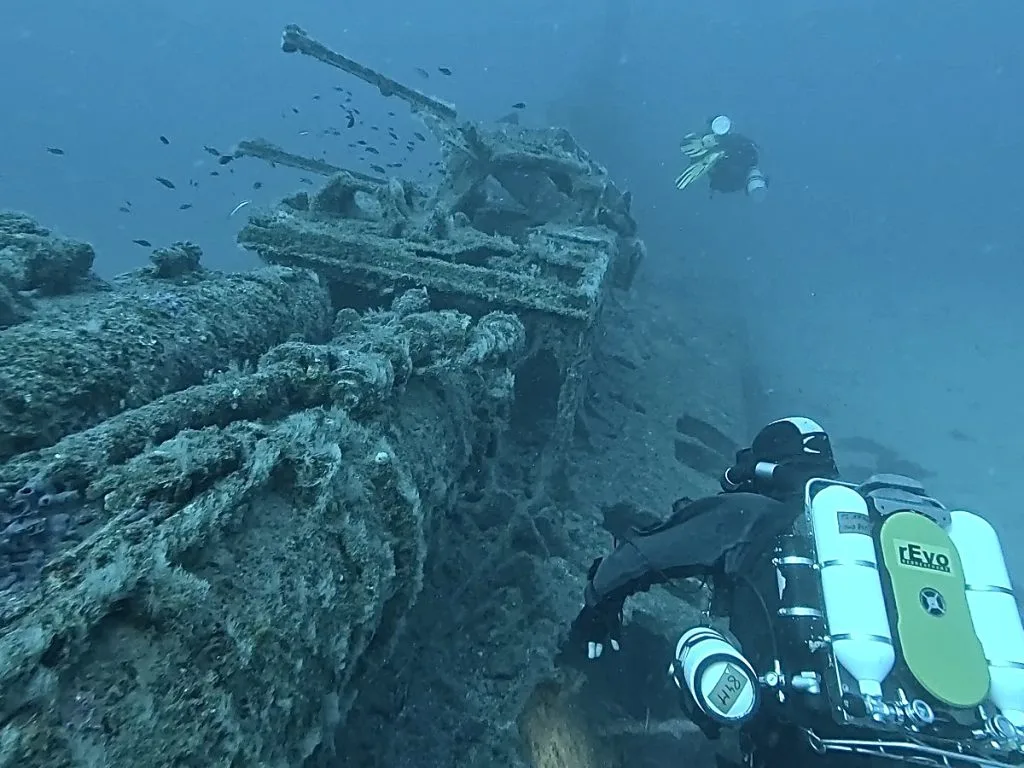
Hydrosphere Plongee is a specialist technical diving school located in Le Teich, serving as a gateway to the challenging wreck sites of the Atlantic. Operating primarily out of the Arcachon area, the centre focuses on the high-level training and support required to explore the deep wrecks stretching from Lacanau to Mimizan, and out towards the Cordouan lighthouse.
Recognised as a 5-star TDI/SDI centre, the school is designed for divers who want to move beyond recreational limits. Whether you are looking to master Nitrox or progress into the complexities of Trimix and closed-circuit rebreather diving, the environment is built around precision, safety, and the specific demands of the Bay of Biscay.
The centre is led by Julien Kenee, a highly experienced instructor with 15 years in the industry. He holds multiple advanced qualifications, including BEES 2, CCR Full Trimix Instructor, and TDI/SDI Trainer, ensuring a high level of technical expertise for all students.
The team is supported by Isabelle Carre, who manages the administrative and organisational side of the centre, and Thomas Froger, who assists with surface safety. All instruction follows the international standards of the RSTC and RESA, providing a consistent and professional approach to technical training.
The course catalogue is extensive, covering the full spectrum from entry-level to advanced technical disciplines. Beginners can start with Open Water Scuba Diver or CMAS Niveau 1, progressing through Advanced Diver and CMAS Niveau 2 and 3 levels.
For those moving into technical diving, the centre offers specialized training in Nitrox, Helitrox, and various stages of Trimix, including 60m, 75m, and 100m levels. Sidemount and wreck-specific training is also available through TDI Sidemount and SDI Wreck Diver courses. The rebreather programme is comprehensive, covering CCR Air, CCR Mixed Gas Diluent, and advanced mixed gas diluent configurations.
The primary vessel is the Dervinis 800 Pro, a robust aluminium boat specifically designed to handle the demands of deep technical diving. It is powered by twin 150 HP Suzuki four-stroke engines, providing the reliability needed for long transits to offshore sites.
The boat is capable of accommodating 10 rebreather divers and is equipped with dual electronic navigation aids to ensure safe passage in the Atlantic. It serves as a stable platform for managing the complex logistics of deep wreck dives and gas switching.
The shore-based facilities are geared towards technical gas blending and high-capacity support. The centre utilises a Bauer compressor for air and a 'Twin Mix' system for gas production. For Nitrox, gas is controlled via an oxymeter, while Trimix blends are verified using a Divesoft system.
For rebreather divers, the centre provides specialised support, including the use of a Reef C2 booster for filling CCR O2 cylinders. The cylinder inventory includes 12l and 15l units for Nitrox and leisure Trimix, alongside various 6l and 7l bail-out cylinders equipped with O2 regulators. Sidemount divers can access S80 and 7l aluminium cylinders, and the centre maintains a selection of rebreathers, including the rEvo, Triton mCCR, AP Diving Evolution, and T-Reb.
The Convoi du 24 Juin 1917 is a deep wreck site located between 70 and 80 metres, requiring rebreather divers in Trimix configuration. It represents one of the most significant technical challenges in the area.
L’Alfred Meyer and Le Balena are impressive wreck sites found at depths of 50 to 65 metres. These sites are intended for divers using normoxic Trimix 20/30 and 18/35.
For those working with Nitrox or rebreathers using an air diluent, shallower wrecks like Le Chariot, Le Tirranna, and Le Remorqueur offer exploration opportunities at depths of 30 to 40 metres.
And some of the dive sites the centre runs.
The marine life in the Bay of Biscay is diverse, with sightings of blue sharks and molas molas adding to the excitement of the deeper dives. You may also encounter sea bass, bass, and various species of porgy.
In the shallower areas and reef flats, the ecosystem supports a variety of crustaceans, including lobster. For those interested in macro life, the area provides opportunities to observe various species of fish like pout.
Fixed life and the surrounding environment provide a varied backdrop to the wreck explorations, with the local fauna adapted to the energetic Atlantic conditions.
Diving in the Bay of Biscay is characterized by demanding conditions. Divers should be prepared for significant currents, varying light levels, and the logistical challenges of offshore navigation.
The Atlantic environment requires robust equipment and experienced handling, particularly when approaching deep wrecks or navigating the distances between the coast and the offshore sites.
Hello, I'm Marina, DivingDeal.com's AI assistant. I answer in detail about hotels, dive centres and liveaboards.

Thinking about the whole trip and the flights? Talk it over with Edith →
Marina is an AI. Some links are affiliate links: DivingDeal may earn a commission, at no extra cost to you. Bookings are made with the partner.
★ 9.4/10 (738 reviews)
4.2 km away as the crow flies

★★★★★
★ 9/10 (466 reviews)
11 km away as the crow flies
★★★
★ 8.7/10 (730 reviews)
6.6 km away as the crow flies

★★★
★ 8.5/10 (1,498 reviews)
6.6 km away as the crow flies