
Scuba Murcia
Google 5/5 (179 reviews)
2.1 km away as the crow flies
Cabo de Palos · Spain · Mediterranean
Max. depth · 24 mA protected rocky formation where large groupers and corvinas hunt amidst Posidonia meadows and ancient anchors.
For subtitles in English: start the video firstthen click the gearat the top right of the video, select “Subtitles/CC”, then “Auto-translate” and choose “English”.
Bajo de Testa is a significant rocky formation situated within the Cabo de Palos – Islas Hormigas marine reserve. Unlike the more exposed and deeper outposts in the region, this site is characterized by a broad plateau that rises from a seabed of approximately 20 to 22 metres up to a shallow crest at 5 to 7 metres. The topography is not a vertical drop but rather a series of gentle slopes and irregular rocky edges. These edges are bordered by extensive meadows of Posidonia oceanica, which provide a complex habitat for many resident species. Navigating the site requires attention to the uneven terrain, as the plateau is broken by blocks, grooves, and small caves.
Approaching the site by boat involves a short navigation close to the coastline, avoiding the open sea to reach the plateau. As you descend onto the reef, you will notice the transition from the surrounding sandy areas to the dense seagrass and coralligenous algae. The structure of the reef is interrupted by a rocky cordon that creates narrow, technical passages and a small cut on the eastern side. These features provide excellent hiding spots for larger fish and contribute to the site's visual complexity. Divers can explore these cracks and crevices to find smaller organisms tucked away in the shadows of the rocky blocks.
The current at Bajo de Testa is generally light, making it a much more sheltered option than the more prominent bajos located further offshore. While the outer reefs are often subject to strong open-sea flows, the conditions here are primarily influenced by general weather and swell rather than heavy tidal currents. This stability makes the site a reliable choice when sea conditions prevent access to more demanding locations. Even in relatively calm periods, the layout of the rocky passages can slightly influence water movement, so maintaining good buoyancy while navigating the narrow cuts is essential for a clean dive.
One of the most distinctive features of this plateau is the presence of scattered large ancient anchors resting on the bottom. These historical artifacts are integrated into the seabed, often partially covered by sediment or surrounded by marine growth. They serve as localized points of interest and often act as hubs for biological activity. Exploring around these anchors allows you to see how the local fauna utilizes man-made objects that have become permanent fixtures of the reef. The combination of these historical elements and the natural rocky structure adds a unique layer to the underwater landscape.
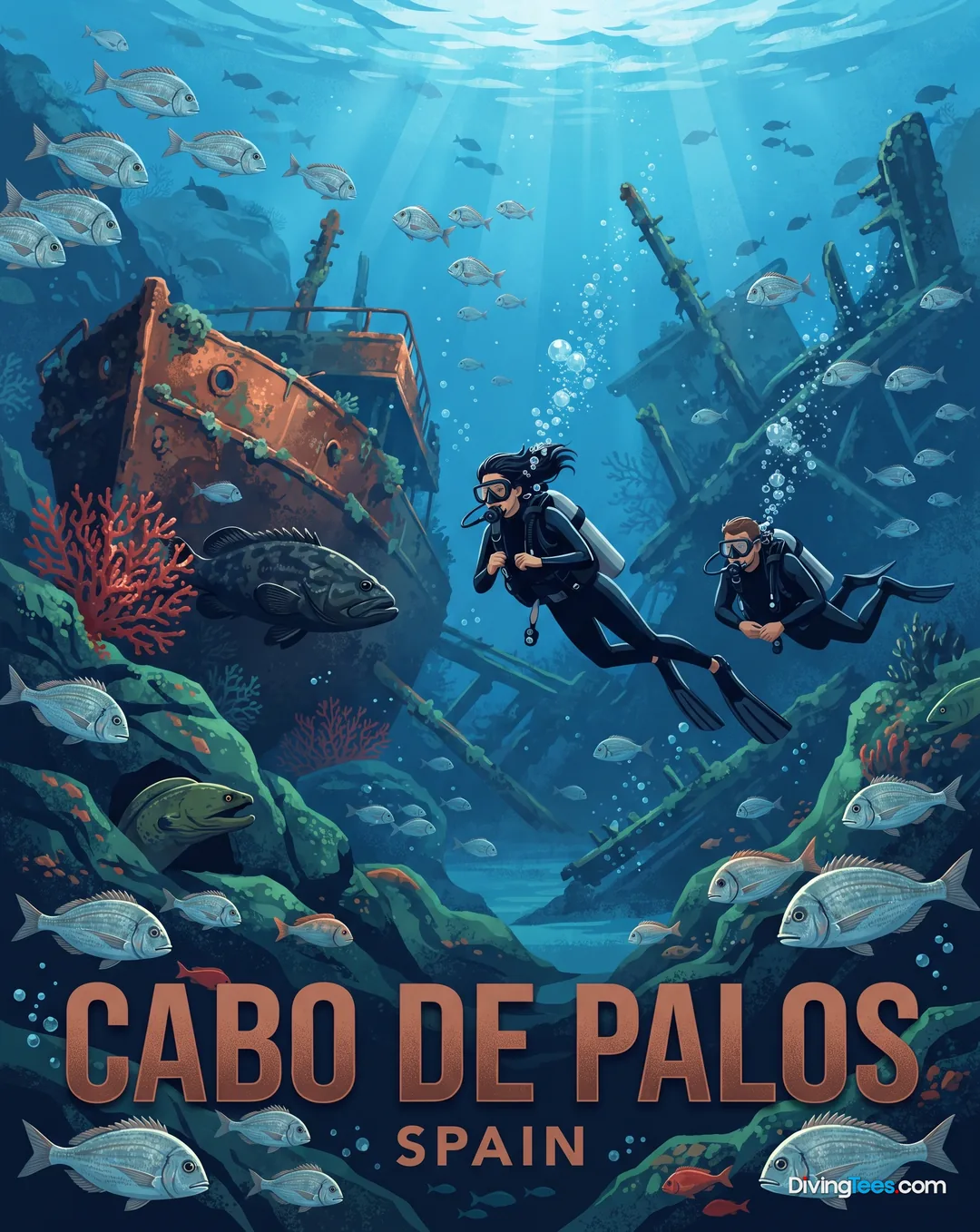
The resident fauna is highly concentrated around the rocky edges and within the protective cover of the Posidonia meadows. Large groupers are a common sight, often found hovering near the edges of the plateau or within the small caves and grooves. You will also encounter corvina, which tend to cruise the transition zones between the rocky reef and the seagrass. These larger predators are often seen hunting amidst dense shoals of smaller fish that inhabit the reef structure. The presence of these large species is a direct result of the high productivity provided by the sheltered, nutrient-rich environment of the reserve.
Mid-water activity is characterized by frequent sightings of various schooling fish that move across the plateau. You can observe dentex, bogue, and bream moving in groups through the water column above the reef. Smaller species like damselfish are prevalent around the coralligenous algae and the immediate edges of the rocky blocks. The biodiversity is supported by the complex architecture of the site, which offers both open space for transit and dense cover for protection. This variety of movement, from the fast-moving schools to the stationary hunters, ensures a visually rich experience throughout the dive profile.
As you move along the slopes, keep an eye out for specialized inhabitants such as fan mussels attached to the rocky surfaces. The interaction between the rocky substrate and the surrounding seagrass creates a high-density habitat that supports a wide range of life. The visibility at the site typically ranges between 15 and 25 metres, providing enough clarity to observe the larger fish from a distance before approaching the reef. Because the site is shallower than many other locations in the area, the light levels remain high, which helps in identifying the subtle textures of the coralligenous growth and the patterns of the resident fish.
The dive depth ranges from 7 to 24 metres. The site is accessible from the Open Water Diver level, though the depth and topography require good buoyancy control. Currents are typically light and sheltered compared to other sites in the area, though visibility is expected to be between 15 and 25 metres. The best time to dive is from spring to early autumn when water temperatures are warmer and conditions are most stable.
You will find the most stable conditions and warmer water at Bajo de Testa from spring to early autumn. The site is reached by a short boat navigation close to the coastline, avoiding the open sea. Visibility typically ranges from 15 to 25 metres, helping you observe the reef and its marine life.
Bajo de Testa is accessible from the Open Water Diver level, but you need good buoyancy control because the site includes uneven terrain, narrow passages, small caves, blocks, grooves, and gentle slopes. The dive depth ranges from 7 to 24 metres, with a plateau rising toward a shallow crest.
Currents at Bajo de Testa are generally light, and the site is sheltered compared with other locations in the area. Water movement is influenced mainly by weather and swell rather than heavy tidal currents. Rocky passages can still alter the flow slightly, so maintain good buoyancy while navigating the narrow cuts.
At Bajo de Testa, you can explore rocky edges, small caves, narrow passages, Posidonia oceanica meadows, coralligenous algae, and ancient anchors on the plateau floor. Large groupers and corvinas hunt near the reef, while dentex, bogue, and bream move in schools. Fan mussels and damselfish also inhabit the rocky surfaces.