
Scuba Murcia
Google 5/5 (179 reviews)
2.6 km away as the crow flies
Cabo de Palos · Spain · Mediterranean
Max. depth · 18 mTwo rocky pinnacles rising from 18 metres create a complex, three-dimensional landscape of columns and passages northwest of Isla de Mouro.
For subtitles in English: start the video firstthen click the gearat the top right of the video, select “Subtitles/CC”, then “Auto-translate” and choose “English”.
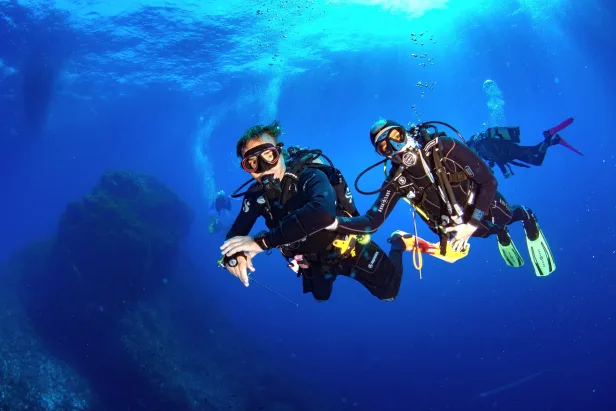
Las Agujas is defined by two distinct rocky pinnacles that rise from the seabed northwest of Isla de Mouro. These structures create a complex, three-dimensional landscape rather than a flat reef, characterized by an oval-shaped reef of irregular rock. You will encounter a variety of vertical formations, including columns, small towers, and overhangs that break up the seabed. This specific topography allows for a diverse dive profile where you can navigate through various rock formations and passages.
The dive profile typically begins at the tops of the pinnacles, where the depth is approximately 7 metres. As you descend, the terrain drops toward the bases near 18 metres. The topography is heavily sculpted, offering numerous crevices and holes that serve as natural shelters for resident marine life. This irregular relief makes the site interesting to explore, as the terrain constantly changes direction and depth throughout the circuit.
A typical dive here follows a circular route around the two main pinnacles. This route often leads you through narrow passages and past various rock towers before heading back toward the island. The layout is designed such that you are essentially navigating a series of interconnected vertical structures. This provides a sense of immersion and discovery as you move between the different sections of the reef.
The site is highly influenced by the swell and tidal flow moving around Isla de Mouro. Because of this, currents can be quite variable, ranging from light to strong. On many days, the movement of water can actually assist your direction as you follow the circular route. You will need to be comfortable managing your buoyancy and maintaining your position when the water movement picks up around the rock faces.
Managing navigation is a key skill at Las Agujas, particularly on days when the current is more pronounced. Using a compass is highly recommended to ensure you maintain your intended course while navigating through the rocky columns and passages. The combination of complex terrain and variable water movement makes this a site that rewards divers who are attentive to their surroundings and their orientation.
The marine life at Las Agujas is largely resident to the rocky structures and crevices. You can find various species of wrasse, including Ballan wrasse and Cuckoo wrasse, patrolling the rocky edges. Other common sightings include Dragonet and Scorpionfish, which often hide within the various overhangs and holes. Large European conger eels are also known to inhabit the deeper cracks and crevices within the rock formations.
The biodiversity continues with sightings of species like the Atlantic cod, European seabass, and Atlantic mackerel. You may also spot various crustaceans and cephalopods, such as the European lobster, Spider crab, and Common cuttlefish, among the rocks. Octopus and various species of anemones are also present in the crevices. For those watching the bottom, there is a high likelihood of seeing various sea urchins and even the occasional Frogfish.
Visibility at Las Agujas is generally good, typically ranging between 10 and 20 metres. This level of clarity allows for excellent observation of the complex details within the rock formations. The combination of the vertical topography and the water clarity makes it an engaging site for observing the textures of the reef and the species that call these pinnacles home.
The dive depth ranges from 7 to 18 metres. This site is accessible for Open Water divers, but it is recommended to have comfortable experience with boat dives and managing currents. Due to the variable currents influenced by tidal flow and swell, navigation skills are essential. The best time to dive here is from June to September, with visibility between 10 and 20 metres.
You can dive Las Agujas from June to September, which is the recommended period for this site. Visibility generally ranges between 10 and 20 metres, allowing you to observe the detailed rock formations, vertical structures, crevices, and marine life around the two pinnacles.
Las Agujas is accessible to Open Water divers, but you should have comfortable experience with boat dives and managing currents. The site ranges from 7 to 18 metres, beginning around the tops of the pinnacles and descending toward their bases through changing vertical terrain.
At Las Agujas, tidal flow and swell create variable currents that can range from light to strong. You should be comfortable managing buoyancy and maintaining your position near the rock faces. Navigation skills are essential, and using a compass is highly recommended while following passages and the circular route.
At Las Agujas, you can explore two rocky pinnacles with columns, small towers, overhangs, narrow passages, crevices, and holes. Resident life includes wrasse, dragonet, scorpionfish, conger eels, cod, seabass, mackerel, lobsters, spider crabs, cuttlefish, octopus, anemones, sea urchins, and occasional frogfish.