Hawksbill Turtle
Eretmochelys imbricata
The most beautiful shell in the ocean is also the most endangered.
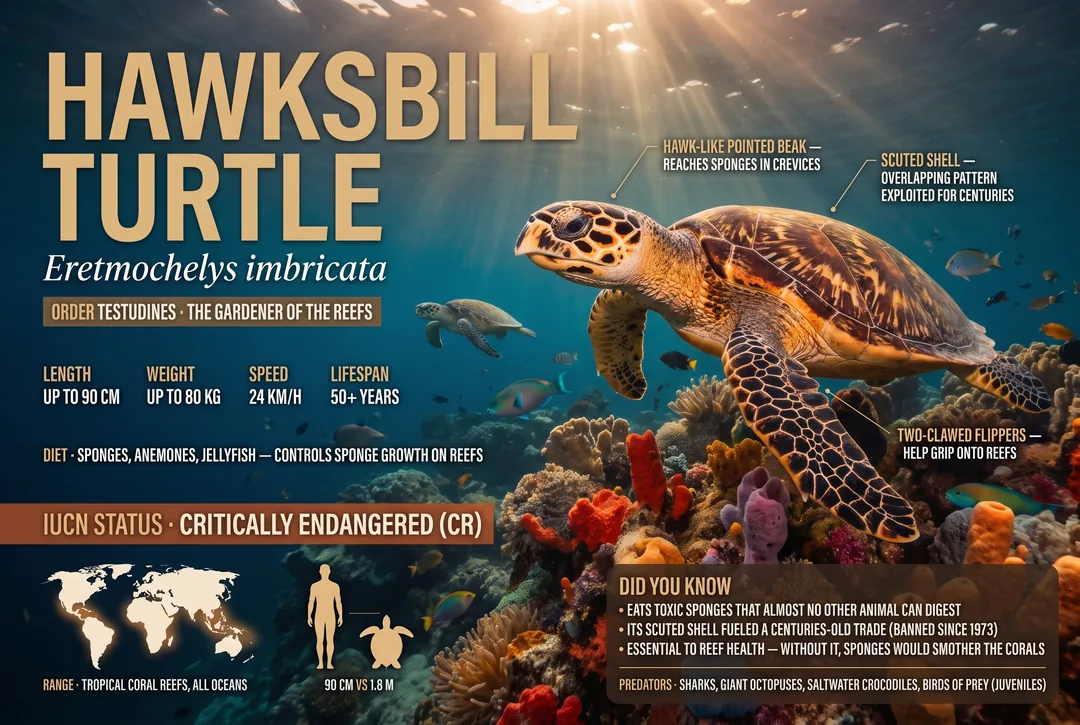
IDENTITY CARD
| Classification | Order Testudines, family Cheloniidae |
| Scientific name | Eretmochelys imbricata (Linnaeus, 1766) |
| Size | 60-90 cm carapace (rarely over 1 m) |
| Weight | 45-75 kg (max recorded: ~127 kg) |
| Speed | Up to 24 km/h in bursts; slow cruising on the reef |
| Lifespan | 30-50 years (estimates up to 60 years in protected areas) |
| Depth | Surface to 70 m, most commonly 1-25 m on the reef |
| Diet | Primarily spongivore — sponges, anemones, jellyfish, algae, small invertebrates |
| IUCN Status | Critically Endangered (CR) — population declined 80%+ over three generations |
PORTRAIT
You recognise her from the far end of the reef before you even check your depth gauge. A narrow silhouette, smaller and more angular than any green turtle, gliding with an unhurried, wing-like stroke toward a sponge-encrusted overhang nobody else would look at twice. She tilts her head, inspects, and begins to feed — the aristocrat of coral reefs, and the one most likely to let you watch her work if you drift in quietly from the side.
Her Latin name says it all: imbricata, covered with tiles. The scutes of her carapace overlap like the shingles of a roof, each one a swirl of amber, black, and deep mahogany that shifts with angle and light. That pattern — unique to every individual, as singular as a fingerprint — is the reason she was hunted nearly to extinction. Between 1950 and 1992, Japan alone imported more than two million hawksbill shells for the bekko trade before the CITES ban finally closed the largest market. The most beautiful shell in the sea became its heaviest burden.
Divers almost always find her eating. Her head is buried in a reef crevice, her narrow beak pulling out sponges that no other vertebrate would touch — structures packed with silica spicules sharp as glass needles and laced with chemical defences that deter virtually every predator on the reef. She is one of the very few animals on Earth that feeds on sponges as a staple, and in doing so she performs a service the reef cannot do without: without her grazing, sponges overgrow and smother the coral beneath, slowly suffocating the ecosystem. She eats poison for a living, and the reef stays alive because of it.
HOW TO RECOGNIZE IT
The beak is the giveaway. Narrow, pointed, and curved sharply downward like a raptor's bill — hence the common name. No other sea turtle has a profile this angular. The carapace carries five vertebral scutes and four pairs of costal scutes whose posterior edges overlap distinctly, especially in juveniles, giving the shell its characteristic serrated outline. Colouring is variable but always striking: an amber or golden-brown base shot through with flames of dark brown and black, sometimes with orange or reddish highlights that catch fire in shallow light.
The plastron is pale yellow, smooth, and largely unmarked. Each front flipper bears two visible claws — a reliable field mark, since the green sea turtle has only one. In the water, the distinction from the green turtle is straightforward once you know what to look for: the hawksbill has a pointed snout and hooked beak where the green turtle shows a rounded, blunt profile; she is smaller (rarely exceeding 90 cm versus 120 cm for a green); and she feeds on sponges clinging to hard reef, not on seagrass beds on the sandy bottom.
For subtitles in English: start the video firstthen click the gearat the top right of the video, select “Subtitles/CC”, then “Auto-translate” and choose “English”.
WAY OF LIFE
The hawksbill is a coral reef inhabitant through and through — and a surprisingly faithful one. Adults maintain a restricted home range, returning to the same stretches of reef season after season. Her diet is dominated by sponges, which can account for 70 to 95 per cent of stomach contents in Caribbean populations. She does not graze indiscriminately: she selects specific sponge species and ignores others, a preference that shapes the community structure of the reef around her. Tunicates, anemones, jellyfish, and algae round out the menu.
Nesting follows the ancient rhythm of natal philopatry: the female returns to the very beach where she hatched, sometimes after decades of wandering and thousands of kilometres of open ocean. She deposits an average of 130 to 160 eggs per nest, repeating the process three to five times in a single season, each clutch laid roughly two weeks apart. Incubation lasts about 60 days, and the sex of every hatchling is determined not by genetics but by the temperature of the sand — above 29.5 degrees Celsius, the clutch produces mostly females. As global temperatures rise, this mechanism is skewing sex ratios dangerously, a trend that compounds every other threat the species already faces.
WHERE TO SEE IT
Maldives. The hawksbill is ubiquitous across most atolls, present on virtually every healthy house reef and channel. She is the turtle you are most likely to see feeding on a Maldivian dive — head down in a sponge, unconcerned, while reef fish hover at a respectful distance. North and South Ari Atoll, Baa Atoll, and the Vaavu channels are particularly reliable year-round.
Sipadan (Borneo). Sipadan is legendary for its turtle density, and the hawksbill is the star of the show alongside its green cousin. Barracuda Point, South Point, and the drop-off wall regularly deliver multiple sightings on a single dive. The island's strict permit system limits daily visitors, which means the turtles here are remarkably tolerant of divers.
Red Sea (Egypt). Ras Mohammed, the Brothers Islands, and the reefs around Marsa Alam all host resident hawksbills. The Brothers in particular — with their steep walls dripping in soft coral and sponge — offer the kind of dramatic reef backdrop that makes a hawksbill encounter feel like a painting. The warm, clear water and abundant light make this one of the best regions in the world for photography.
Seychelles. The granitic inner islands and the remote Aldabra Atoll are among the most important hawksbill nesting sites in the western Indian Ocean. Cousin Island, managed as a nature reserve since 1968, runs one of the longest-running sea turtle monitoring programmes in the world. Diving encounters are common around Mahe, Praslin, and the outer islands, especially outside the southeast monsoon.
Caribbean — Bonaire, Curacao, Belize. Bonaire's fringing reef, protected as a marine park since 1979, is home to a healthy resident population visible on almost any shore dive. Curacao offers similar encounters on its leeward coast. Belize adds the Mesoamerican Barrier Reef — the largest in the Western Hemisphere — where hawksbills cruise the walls and spur-and-groove formations from Turneffe Atoll to Glover's Reef.
OBSERVATION CALENDAR
Click each button to show/hide
Hawksbills are resident year-round on most tropical reefs. Seasonal variation reflects diving conditions and nesting activity rather than the turtles' absence — the Maldives and southern Caribbean offer encounters in every month, while Seychelles diving is limited during the southeast monsoon (June to September).
CONSERVATION
Eretmochelys imbricata is classified as Critically Endangered (CR) on the IUCN Red List — the last category before extinction in the wild. The global population has declined by more than 80 per cent over three generations, a span of roughly 105 years. The species is listed on Appendix I of CITES since 1977, banning all international trade.
The historical shell trade was the primary driver of collapse. Japan's bekko industry imported over two million hawksbill shells between 1950 and 1992, and a black market persists today in Southeast Asia and Central America. Other threats compound the damage: egg poaching on nesting beaches, coral reef destruction, bycatch in fishing gear, ingestion of plastic debris, and climate warming — which, by raising sand temperatures, produces increasingly feminised clutches and undermines the demographic balance the species needs to recover.
There are reasons for cautious hope. Protected nesting programmes on Cousin Island in the Seychelles, at Tortuguero in Costa Rica, and across Bonaire have achieved hatching rates of 70 to 80 per cent. Japan's shell import moratorium in 1993 cut the single largest market overnight. But recovery is measured in decades, not years — hawksbills take 20 to 35 years to reach sexual maturity, and every generation lost deepens the hole.
Organisations to support:
- Sea Turtle Conservancy — the world's oldest sea turtle research and conservation organisation, founded in 1959
- Turtle Foundation — hawksbill and green turtle protection programmes in Indonesia and Cape Verde
- SEE Turtles — community-based conservation and anti-poaching initiatives across Latin America
- PADI AWARE — global diver-driven marine conservation, citizen science, and sighting reporting
3 THINGS YOU PROBABLY DON'T KNOW
1. She eats poison for breakfast. The sponges that make up most of her diet are packed with silica spicules as sharp as glass needles and chemical defences toxic enough to repel virtually every other animal on the reef. Her digestive system neutralises these compounds without apparent difficulty. The consequence is darkly ironic: because toxins accumulate in her flesh, eating hawksbill meat can cause severe chelonitoxism in humans — a poisoning that is sometimes fatal and for which there is no antidote.
2. Her shell is a reef in itself. A single hawksbill carries a miniature ecosystem on her back — epiphytic algae, barnacles, bryozoans, small crustaceans, and encrusting organisms that colonise the textured surface of her overlapping scutes. A study in the Maldives recorded more than 100 species living on a single individual. As she moves from reef to reef, she transports this micro-community across the ocean, a dispersal role whose ecological significance is only beginning to be measured.
3. She finds her birth beach to within a degree. After 20 years of wandering and thousands of kilometres of open-ocean migration, a nesting female returns to the exact beach where she hatched — not just the same coastline, but the same stretch of sand. She navigates using the Earth's magnetic field: each beach has a unique magnetic signature that the hatchling memorises at birth and carries for life. Females displaced experimentally by 100 kilometres have found their way back to their home beach in a matter of days.
PHOTO AND VIDEO TIPS
The hawksbill is one of the most photogenic subjects in underwater photography — and one of the most cooperative, provided you read her body language and respect her space.
Lens. Wide angle is the first choice for reef context: a 10-17 mm fisheye or 14-24 mm rectilinear captures the turtle against her coral habitat and gives the image a sense of place. Switch to a macro lens (60 mm or 100 mm) for tight head and beak close-ups — the intricate pattern of scales around the eye and the hooked tip of the beak reward the detail.
Light. At the typical encounter depth of 5 to 15 metres, natural light is abundant and does most of the work. Low-power strobes or continuous lights add punch under overhangs and in crevices, where the amber tones of the carapace come alive with a touch of artificial light. Avoid blasting a resting turtle with full-power strobes — it serves neither the image nor the animal.
Approach. Come from the side, never from above — a shadow falling over a feeding hawksbill will send her gliding away before you fire a single frame. Settle at the same level, two to three metres away, and wait. A turtle that continues feeding has accepted your presence; one that lifts her head and locks eyes is deciding whether to stay. Patience at that moment is everything.
Classic mistake. Photographing the back. An overhead shot of a hawksbill produces a brown oval with flippers — the most boring possible rendering of the most beautiful shell in the sea. The images that stop a viewer are frontal — the hooked beak, the dark thoughtful eye, the texture of the facial scales — or lateral, silhouetted against the blue with the carapace backlit by the sun. Seek the eye. It is dark, deep, and ancient, and it gives the photograph a soul that no amount of colour or composition can replace.