
Gran Canaria Divers
Google 4.9/5 (473 reviews)
less than 1 km away as the crow flies
Gran Canaria · Canary Islands · Atlantic
Max. depth · 22 mDescend to 20 metres to explore the Cermona II, a 32-meter fishing vessel resting on its starboard side on a sandy and rocky seabed.
For subtitles in English: start the video firstthen click the gearat the top right of the video, select “Subtitles/CC”, then “Auto-translate” and choose “English”.
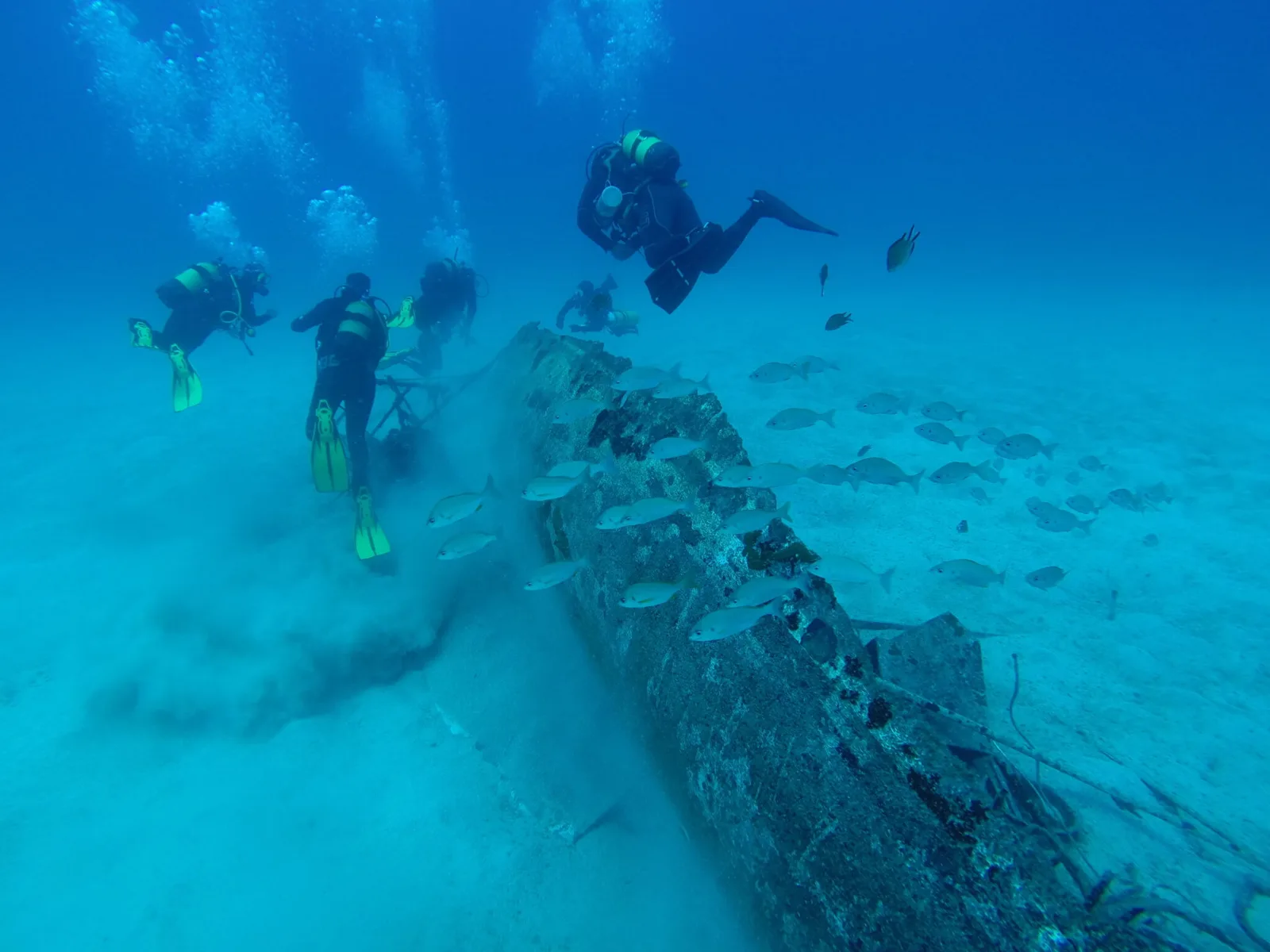
The Cermona II wreck lies off the south coast of Gran Canaria, a 32-meter steel-hulled fishing vessel intentionally sunk in 2002 to create an artificial reef. It rests on its starboard side on a mixed sandy and rocky bottom, approximately 40 to 60 metres from the older Alagranza wreck. The dive typically begins with a boat access from Puerto de Mogán, a short five-minute navigation, followed by a descent on a fixed line attached directly to the wreck. This setup allows for a controlled and straightforward approach to the site, orienting you to the vessel's profile as you near the main deck.
As you approach the Cermona II, the wreck's structure becomes clear, lying at a maximum depth of 22 metres, with the surrounding seabed ranging from 16 to 21 metres. The vessel's orientation on its side means that parts of the ship which would normally be vertical are now horizontal, offering a unique perspective on its interior spaces. This angle also creates sheltered areas on the leeward side, providing refuge for smaller marine life. The wreck is largely intact, giving a good sense of the original vessel's form and allowing for comfortable exploration along its length.
Exploration of the Cermona II includes its holds and engine room, which are accessible for properly trained divers. These interior spaces present a different environment from the exterior, with reduced light and often distinct inhabitants. When penetrating, maintaining neutral buoyancy is crucial, and you must always be mindful of overhead environments, especially within the more confined sections. The structure's integrity allows for a clear navigation path, making it an ideal site for divers looking to develop their wreck diving skills in a relatively contained area.
The exterior of the wreck is covered in fine algae and marine growth, transforming it into a vibrant habitat that draws abundant fish life. As you follow the length of the vessel, you'll encounter various species such as parrotfish, grunts, and trumpetfish schooling around the structure. Damselfish and sea bream are also common sights, adding to the dynamic ecosystem that has developed around this artificial reef. The contrast between the exterior growth and the darker interior spaces provides a diverse diving environment.
Within the protection of the wreck, moray eels and dusky groupers often make their home, frequently found near openings or within sheltered sections of the structure. Crustaceans and molluscs inhabit the numerous nooks and crannies, offering macro opportunities for observant divers. The surrounding sandy and rocky seabed extends beyond the wreck itself, providing additional areas to observe local fauna, including occasional stingrays that glide across the bottom.
While the current at the Cermona II is typically weak, it can be variable, ranging from mild to moderate, with occasional stronger flows. It's always prudent to monitor conditions throughout the dive, particularly when planning your return to the ascent point, as conditions can shift. Occasionally, larger pelagic species such as amberjacks (Seriola dumerili) and tuna may pass by the wreck, especially if there's a gentle current bringing in nutrients, highlighting the Cermona II's role as an aggregation point in the open marine environment.
The Cermona II offers a focused wreck dive experience without extreme depths, making it approachable for divers seeking to gain wreck diving experience. The clear structure and relatively contained exploration area allow for multiple dives to fully appreciate its details and observe the marine life settling into its new habitat. The site is regularly visited by the tourist yellow submarine from Puerto de Mogán, which can add a distinctive, if sometimes distracting, feature to the dive experience.
The Cermona II is accessible from Open Water Diver certification, though some guides recommend Advanced Open Water due to the depth and occasional currents. The maximum depth reached at the wreck is 22 metres, with the surrounding seabed between 16 and 21 metres. Visibility typically ranges from 15 to 30 metres. While currents are generally weak, they can be variable, so be prepared for occasional moderate flow. The best conditions for diving here are typically from May to October, when seas are calmer, visibility peaks, and water temperatures are warmer.
You will generally find the best diving conditions at Cermona II from May to October. During this period, the seas are calmer, visibility peaks, and water temperatures are warmer. The wreck is reached by boat from Puerto de Mogán, with a short navigation followed by descent along a fixed line attached to the wreck.
Cermona II is accessible with an Open Water Diver certification. Some guides recommend Advanced Open Water training because of the wreck’s depth and occasional currents. Exploring the holds and engine room requires appropriate wreck-diving training, careful buoyancy control, and awareness of overhead environments, particularly in the more confined interior sections.
At Cermona II, the wreck reaches a maximum depth of 22 metres. The surrounding sandy and rocky seabed lies between 16 and 21 metres, while the main deck is accessible from 20 metres. The wreck rests on its starboard side, creating a different perspective on its structure and interior spaces.
Currents at Cermona II are generally weak but variable, ranging from mild to moderate, with occasional stronger flow, so monitor conditions during the dive and return. You may see parrotfish, grunts, trumpetfish, moray eels, groupers, crustaceans, molluscs, and occasional amberjacks, tuna, or stingrays around the wreck and seabed.