

Dive Community La Palma
Google 5/5 (548 reviews)
23 km away as the crow flies
La Palma · Canary Islands · Atlantic
Max. depth · 45 mExplore a submerged memorial of stone crosses set against a massive volcanic needle and deep black coral.
For subtitles in English: start the video firstthen click the gearat the top right of the video, select “Subtitles/CC”, then “Auto-translate” and choose “English”.
The Malpique site offers two distinct underwater landscapes located off the coast of La Palma. The first is the area known as Las Cruces, where approximately 40 stone crosses lie on the seabed at depths between 16 and 25 metres. These monuments were submerged in 1999 to honor the martyrs of Tazacorte and rest upon a floor of black volcanic sand and rock. Navigating this section provides a quiet, contemplative descent through a field of historical markers that contrast sharply with the dark volcanic substrate.
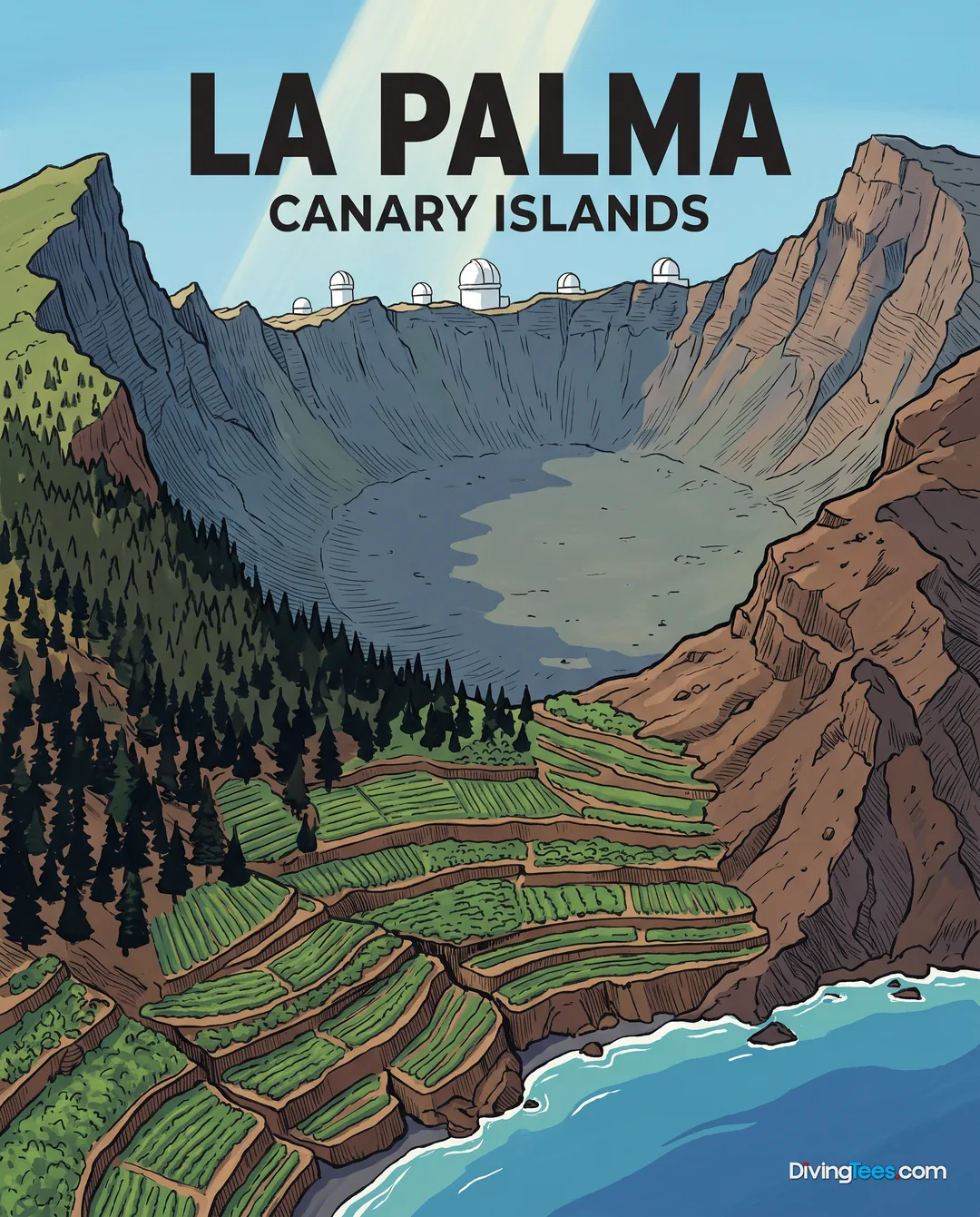
Moving away from the crosses, the topography shifts toward the Torre de Malpique, a massive volcanic needle that rises vertically from the depths. This geological structure starts its ascent from approximately 50 metres and extends upward through the water column. The sheer scale of the tower provides a significant vertical element to the dive, serving as a primary landmark for navigation. The surrounding terrain is composed of rugged volcanic formations that create various crevices and overhangs for marine life to inhabit.
At approximately 38 metres, the Torre de Malpique features a large rock arch that serves as a focal point for deeper dives. Passing through or around this arch allows you to observe the transition in light and structure as the volcanic walls drop away. This section of the site is where the geological complexity is most evident, with the verticality of the spire creating different micro-environments. The depth in this zone requires careful buoyancy control to manage the proximity to the reef walls.
The biological highlight of the Torre de Malpique is the presence of black coral covering the volcanic relief. These organisms thrive on the vertical surfaces of the spire, where they can access nutrient-rich currents. Observing the delicate structure of the black coral against the dark, textured volcanic rock provides a distinct visual experience. The placement of the coral on these deep, vertical rises makes the Torre a specific destination for those interested in deep-water sessile life.
Current conditions at Malpique are highly dependent on the state of the sea and local swell patterns. The site can experience strong currents that fluctuate based on the direction of the waves and tidal movements. Divers should be aware that conditions are particularly unpredictable when there is a heavy swell coming from the west. Effective planning is required to ensure you can manage the drift, especially when navigating near the large volcanic structures or the deep arch.
Approaching the site requires different methods depending on which section you intend to dive. Las Cruces can be reached from the shore via a rocky access point located near the Fuencaliente lighthouse. In contrast, the Torre de Malpique is typically accessed from a boat in open water, as it sits further out and requires specific maritime conditions to safely enter the water. Because the Torre is more exposed to oceanic conditions, it is often more selective regarding the daily dive windows.
The visibility at Malpique is generally high, ranging from 20 to 50 metres, which allows for clear views of the volcanic landmarks. This clarity is essential for appreciating the scale of the Torre and the detail of the stone crosses on the sandy bottom. Even at the deeper limits of the site, the light penetration helps define the contours of the volcanic needle and the dark corals. Maintaining a steady ascent rate is important as you move between the deeper sections of the tower and the shallower memorial area.
Planning a dive here requires a focus on both depth management and current awareness. The site spans a depth range from 16 to 45 metres, meaning you will encounter significant pressure changes during your profile. The combination of deep vertical walls and potentially strong currents makes this a site for those who are comfortable with more demanding environments. Understanding the relationship between the swell and the current will help you decide when to target the Torre versus the shallower crosses.
The site depth ranges from 16 to 45 metres. An Advanced level is required, with specific experience in managing currents and depth necessary for the Torre de Malpique section. Visibility typically ranges between 20 and 50 metres. Diving is not recommended during a full moon or when a swell is coming from the west, as currents can become strong.
You should plan Malpique around calm sea conditions. Diving is not recommended during a full moon or when swell arrives from the west, because currents can become strong. The Torre de Malpique is more exposed and is accessed by boat, so its daily dive window depends on suitable maritime conditions.
You need an Advanced level for Malpique, especially if you plan to visit the Torre de Malpique. Experience managing currents and depth is specifically required there. The site combines deep vertical walls, changing conditions and potentially strong currents, so you should be comfortable in demanding underwater environments.
Malpique ranges from 16 to 45 metres. In the shallower Las Cruces area, you can see approximately 40 stone crosses on black volcanic sand and rock. Deeper sections feature a massive volcanic needle, a large rock arch at 38 metres, rugged formations, and black coral on volcanic reliefs.
You can encounter strong, fluctuating currents at Malpique, influenced by wave direction and tidal movements. Conditions become particularly unpredictable with heavy swell from the west. You should be prepared to manage drift near the volcanic structures and deep arch, while high visibility between 20 and 50 metres helps reveal the terrain.