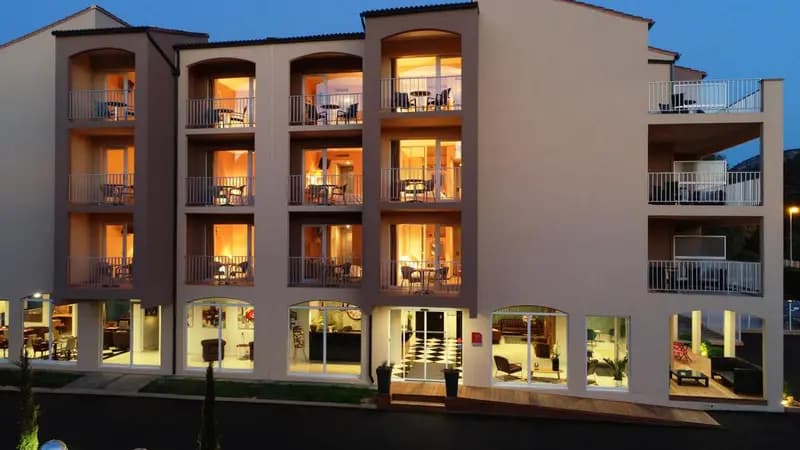

Hôtel L'Escale Coté Port
★★★
★ 9.2/10 (1,315 reviews)
18 km away as the crow flies
Dive centre · Corse · France
4.835 Google reviewsDive from a dedicated marine research station situated on the granite cliffs of the Cap de la Revellata.
For subtitles in English: start the video firstthen click the gearat the top right of the video, select “Subtitles/CC”, then “Auto-translate” and choose “English”.
Located at the tip of the Cap de la Revellata in Calvi, STARESO is far more than a standard dive centre. Established in 1972, it functions as a dedicated marine research station for the University of Liège, designed to allow scientists to work with their feet in the water. The facility is built from granite and integrated into the landscape, offering a sense of isolation and connection to the sea that is rare in the region.
The station serves as a bridge between professional oceanographic research and the diving public. While its primary mission involves studying Mediterranean biology, chemistry, and physics, it provides a high-quality diving infrastructure for those wanting to experience the exceptional water purity of the Corsican coast. It is a place where science meets exploration.
The centre is managed by Gérard Bonifacio and operates with a strong focus on marine science. Because of its academic roots, the environment is geared towards those interested in the biological and environmental aspects of the Mediterranean.
Beyond standard diving, STARESO offers specialised training in marine biology and oceanography. These programmes are designed to bring the complexities of the underwater world to a wider audience, ranging from students to the general public.
STARESO offers specialised educational programmes that go beyond standard diving certifications. You can participate in introductory courses and formal training in marine biology and oceanography, designed to deepen your understanding of the Mediterranean ecosystem.
These scientific training modules are ideal for divers who want to combine their underwater skills with a formal study of the marine environment.
The centre operates a diverse fleet of five vessels to access the local dive sites. This includes two 9m plastic fast boats powered by twin 115 CV engines, as well as a 9m aluminium barge with a 200 CV engine for more stable platform requirements.
For smaller groups or specific access needs, there are two 5m aluminium barges powered by twin 40 CV engines, and a lightweight zodiac with a 15 CV motor. The variety of craft allows the centre to adapt to different sea conditions and diver requirements.
The station is equipped with full diving kit hire, including wetsuits, regulators, fins, and masks. The infrastructure is designed to support both scientific research and recreational diving, with a dedicated diving area and a sheltered port.
Accommodation is available directly on-site, which includes 25 student-style rooms on the base, two individual rooms on the base, and ten individual rooms located within the lighthouse itself. On-site catering is also provided, allowing divers to remain at the station between trips.
The marine life around the Cap de la Revellata is noted for its abundance and diversity, supported by the exceptional purity of the water. The surrounding reefs and seabed host a wide variety of Mediterranean flora and fauna.
In the seagrass meadows and rocky areas, you will find a rich array of marine life. The biodiversity of the site is a direct result of its protected and isolated location, which has helped preserve the natural habitats from significant pollution.
Hello, I'm Marina, DivingDeal.com's AI assistant. I answer in detail about hotels, dive centres and liveaboards.

Thinking about the whole trip and the flights? Talk it over with Edith →
Marina is an AI. Some links are affiliate links: DivingDeal may earn a commission, at no extra cost to you. Bookings are made with the partner.