
Ecole de Plongée de Tahiti
Google 5/5 (183 reviews)
Tahiti · French Polynesia · Pacific
Max. depth · 60 mThe geological structure of this site creates a vertical playground of cracks and overhangs dropping from a shallow plateau into the open ocean.
The topography of the Faults of Arue is defined by a series of perpendicular geological cracks that break the continuity of the reef. These faults create a steep wall that descends from a shallow coral plateau into the deep ocean. As you descend, the structure transitions from a relatively flat platform into a vertical drop-off. This geological instability is what gives the site its name and its character, providing a complex landscape rather than a simple sloping reef.
The dive profile starts at a shallow depth of approximately 5 metres on the upper plateau. As you move toward the edge, the seabed begins to drop away more sharply, reaching depths of 15 metres where the main wall structure becomes apparent. The terrain becomes increasingly complex as you descend further, moving past rock overhangs and natural roofs. This layout requires careful buoyancy control, especially when navigating the transition from the plateau to the steeper sections of the wall.
Between 25 and 33 metres, the faulting produces a significant undersea cavern. This feature acts like a large doorway set directly into the steep wall, offering a unique perspective of the reef's vertical structure. Navigating through or along this cavern allows you to see how the current interacts with the rock faces. It is one of the most distinctive features of the site, providing a sense of scale and depth that sets it apart from standard reef walls.
Visibility at this site is typically consistent, ranging between 20 and 30 metres. This clarity is essential for observing the transition between the reef edge and the open ocean. The visibility allows you to track the descent of larger species as they move between the reef and the blue. When the water is clear, the light penetration into the cracks and the mouth of the cavern provides excellent detail of the geological formations.
The resident marine life is concentrated along the vertical faces of the faults. You will find various species of surgeonfish and gorgonians clinging to the reef structures. For those looking closer at the crevices, crayfish are frequently found sheltering within the rocks. These smaller creatures utilize the cracks and overhangs for protection from the surge and currents that move along the outer edge of the reef.
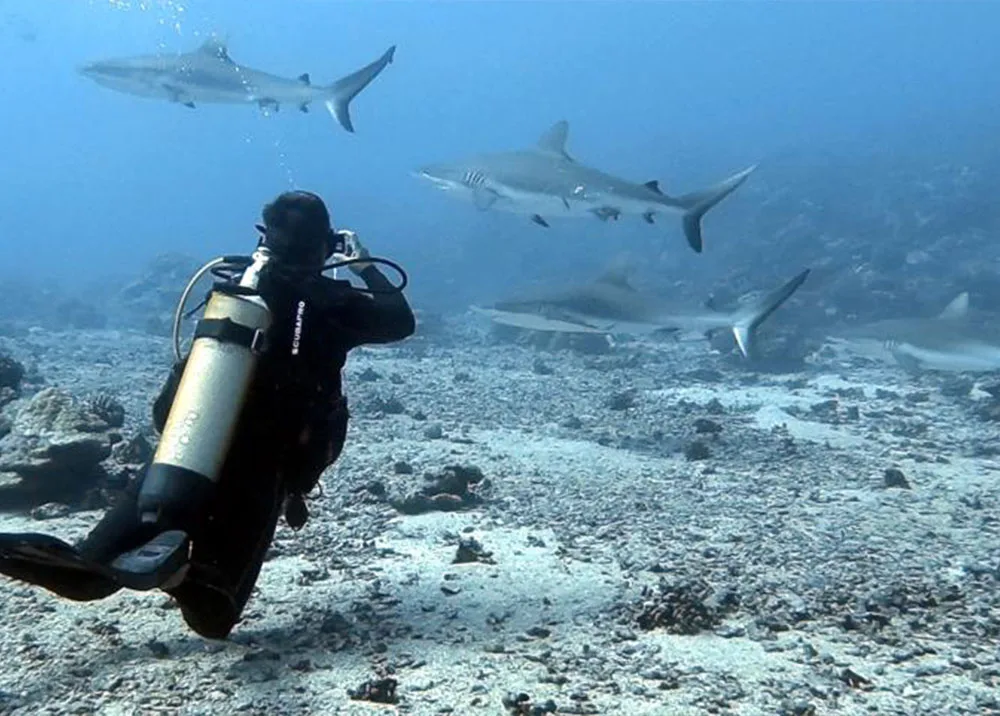
The site is particularly known for the presence of pelagic species that patrol the edge of the drop-off. While the reef life remains fixed to the wall, larger fish move through the water column near the deeper sections of the fault. This proximity to the open ocean ensures that you can experience both the intricate detail of the reef and the presence of larger oceanic species in a single descent. The verticality of the site makes it an ideal location for spotting these movements.
Currents at the Faults of Arue can vary depending on the ocean swell and the tide. You may notice increased water movement as you approach the outer reef slope, particularly in the first 10 metres of the descent. These currents are influenced by the trade winds on the east coast of Tahiti. Local conditions require close attention to the swell to determine the best time to enter the water and to manage the ascent safely.
The site reaches depths of 60 metres. It requires an Advanced level certification and significant experience, ideally at least 50 logged dives, due to the deep wall and cavern profiles. Currents can be variable and are influenced by swell and tides, particularly near the drop-off and in the upper 10 metres.
You should pay close attention to ocean swell and tides before entering The Faults Of Arue. Water movement can increase near the outer reef slope, especially in the upper 10 metres. Trade winds on Tahiti’s east coast also influence conditions, so local swell assessment helps determine a suitable entry and ascent.
The Faults Of Arue requires an Advanced level certification and significant experience, ideally at least 50 logged dives. Its deep wall and cavern profiles demand careful buoyancy control, particularly while moving from the shallow coral plateau toward steeper sections, rock overhangs, natural roofs, and the vertical drop-off.
The Faults Of Arue ranges from about 5 to 60 metres. You begin on a shallow coral plateau, pass the main wall near 15 metres, and reach a large cavern between 25 and 33 metres. The site continues into deep vertical faults, with a transition from reef edge to open ocean.
Currents at The Faults Of Arue vary with swell and tides, becoming more noticeable near the drop-off and in the upper 10 metres. You can see gorgonians, surgeonfish, and crayfish in the faults and crevices, while pelagic species patrol the deeper edge. Visibility typically ranges between 20 and 30 metres.