
Dive Bluemotion
Google 4.8/5 (102 reviews)
Indonesia · Asia
Lava flows, coral gardens, current-swept pinnacles, hammerhead sharks and schools of trevally define boat diving from Banda Naira
Gunung Api’s black lava flow drops beneath clear water and carries coral growth across a landscape still marked by the volcano. From Banda Naira, boats reach walls, slopes, pinnacles and reef systems around Hatta, Ai, Banda Besar and neighbouring islands. Some dives are sheltered and straightforward, while others put you in open water with current and a blue-water descent. The attraction is the change of scene from one outing to the next, with volcanic geology always close beneath the reef.
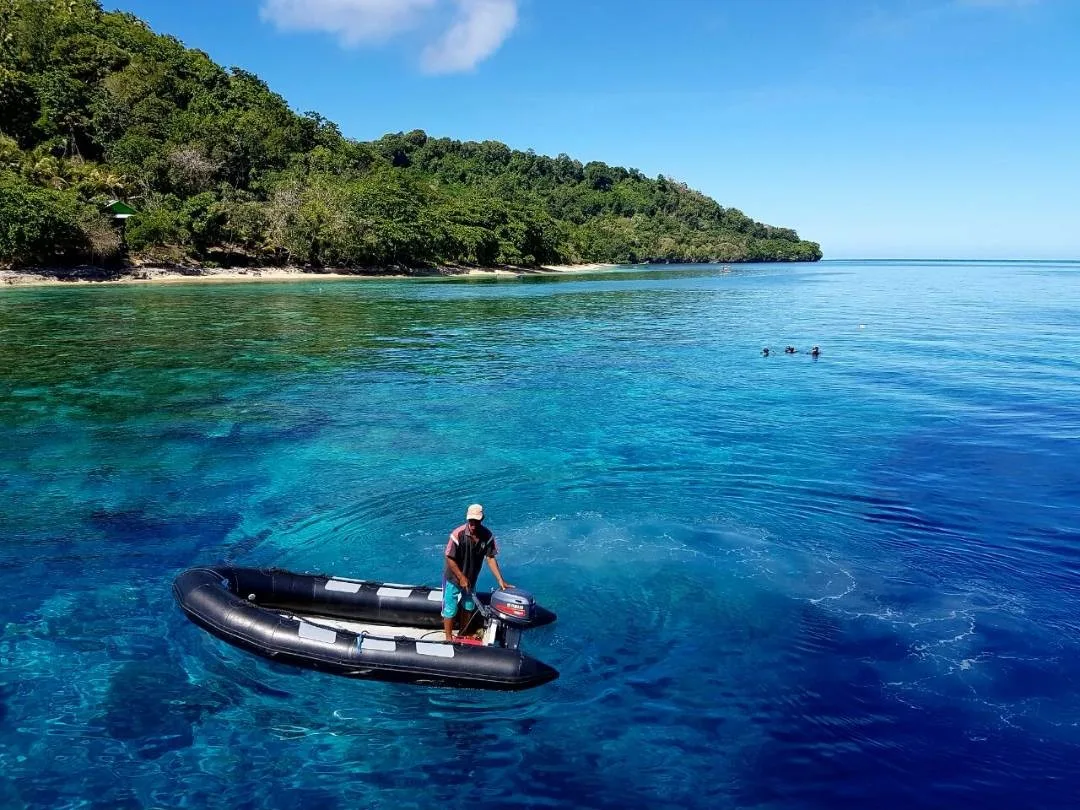
Most diving is by day boat, using Banda Naira as a base for reefs and walls around the neighbouring islands. Sonegat and Lava Flow offer more sheltered alternatives, while Batu Kapal, Karang Hatta and exposed sites around Ai and Hatta involve pinnacles, open water and variable current. Expect sloping reefs, steep walls and coral growing over Gunung Api’s 1988 lava. A drift dive may be part of the plan, but conditions decide whether the boat can hold position or the group must move with the water. Visibility commonly sits between 15 and 30 metres, although harbour areas, sandy bottoms and stirred-up water can be much less clear. Advanced divers should be comfortable with a downcurrent possibility, regrouping in open water and completing a controlled ascent and safety stop in changing conditions.
The reef scenery includes coral growth on the Gunung Api lava flow, healthy sections of sloping reef and blue-water walls where trevally may gather. Napoleon wrasse and pelagic groupers are among the larger reef encounters, while the Banda Islands can produce seasonal pelagic interest. Hammerhead sharks are an occasional possibility, with the strongest window around October and November, although sightings can extend more broadly from September to April. Oceanic manta rays are occasional, and tiger sharks and thresher sharks are rare rather than dependable targets. The value of these encounters lies in their uncertainty: the same boat programme can shift from coral detail and sheltered reef life to a wide-water look for passing animals.
The most useful periods are March and April, then September through November and early December. These transition months, together with part of the dry season, generally bring more navigable water, better visibility and better access to exposed islands. Visibility is often favourable from August to April, especially from September to November and March to April. June, July and August are more vulnerable to monsoon swell, uncomfortable crossings and cancelled trips to outer sites. Hammerheads add a reason to favour October and November, but they remain occasional visitors. Allow for busier boats during the main seasonal windows, while accepting that quieter months may mean lost access rather than empty dive sites.
Banda Naira is not reserved for technical or highly experienced divers. Sheltered reefs and shallower sites can suit newer divers, provided the local conditions are assessed honestly. The more exposed walls and pinnacles are a different proposition, combining depth, current and open-water procedures. An Advanced Open Water qualification, or equivalent experience, is useful for these outings. Divers arriving through BSAC, PADI or SSI should be comfortable holding position, responding to a downcurrent and keeping a reliable surface regrouping routine before committing to the outer sites.
From London or Manchester, travel first to Ambon, then cross to Banda Naira. The crossing is the structural constraint: a PELNI ferry usually takes about eight to ten hours, a seasonal fast boat about five to six hours, and a small chartered flight about forty-five to sixty minutes when operating. Connections commonly require a night in Ambon because departures for Banda often leave in the morning. Do not build a tight return connection around the crossing. Once on Banda Naira, accommodation and the jetties are generally close to the centre, so local movements are on foot or by short land transfer before the diving is done by boat.
Keep spare days for the transport, not just for extra diving. A calm departure from Ambon does not guarantee calm passages around Hatta, Ai or the other outer islands, so leave exposed sites and pelagic plans until the sea is genuinely suitable. Keep Sonegat or Lava Flow available as a fallback rather than forcing an advanced wall as the first dive. Bring the personal equipment you depend on, particularly photography accessories, a suitable exposure suit and anything useful for current work, because Banda Naira’s isolation limits replacement options. Plan current sites with the local guide and the day’s sea state, not around a fixed sequence. Leave a generous margin before the flight home, since a delayed ferry or fast boat can cost a night in Ambon. Treat Banda Naira as a diving base with a small cultural hinterland, not as a resort where every day can be improvised ashore.
A seven- to ten-day stay gives the crossing some breathing space and allows several day boats towards Gunung Api, Hatta, Ai, Banda Besar and outer reefs when conditions permit. Accommodation is generally near Banda Naira’s centre and embarkation points. Non-diving time works well for the forts and spice-trade history, nutmeg plantations, village walks, volcanic viewpoints and occasional snorkelling around Pulau Ai or Gunung Api. Keep a land-based day before the return journey rather than filling every available morning with diving.
Hello, I'm Marina, DivingDeal.com's AI assistant. I guide you through destinations, areas and countries.
Thinking about the whole trip and the flights? Talk it over with Edith →
Marina is an AI. Some links are affiliate links: DivingDeal may earn a commission, at no extra cost to you. Bookings are made with the partner.
Choose March or April, or visit from September through November and into early December, when access to exposed islands and visibility are generally more favourable. August through April can offer good visibility, while June, July and August are more vulnerable to monsoon swell, uncomfortable crossings and cancelled outer-site trips. Hammerheads are most likely around October and November.
Banda Naira has sheltered reefs and shallower sites suitable for newer divers when conditions are assessed carefully. Exposed walls and pinnacles require comfort with depth, current and open-water procedures. You should be able to hold position, respond to a possible downcurrent, regroup at the surface and complete a controlled ascent and safety stop.
You can explore coral growing across Gunung Api’s black lava flow, sloping reefs, steep walls and current-swept pinnacles. Trevally, Napoleon wrasse and pelagic groupers may appear, while hammerheads are an occasional seasonal possibility. Oceanic manta rays are also occasional, and tiger sharks and thresher sharks are rare rather than dependable encounters.
Use Banda Naira as a base for day boats to Gunung Api, Hatta, Ai, Banda Besar and nearby reefs. Travel through Ambon and allow flexibility for ferry, fast-boat or flight delays, including a possible overnight connection. Keep spare days, retain sheltered sites as fallbacks, and leave time before your return flight.