
BeFreeToDive, BeFree2Dive
★ 4.9/5 (200 reviews)
66 km away as the crow flies
Nice · France · Mediterranean
Max. depth · 34 mDescend to 32 meters to explore Le Prophète, a historic steamship sunk in 1860, revealing its massive transmission wheel and well-preserved propeller.
For subtitles in English: start the video firstthen click the gearat the top right of the video, select “Subtitles/CC”, then “Auto-translate” and choose “English”.
Le Prophète, a cargo steamship launched in 1853, met its end in 1860 near Nice. This wreck lies at a maximum depth of 34 meters, with its main structures accessible between 28 and 32 meters. As you descend, the contours of the vessel become apparent, revealing a spread of debris over approximately 50 meters of seabed that marks its final resting place. The intact propeller at the stern immediately captures attention, making it clear this is a wreck with significant historical integrity.
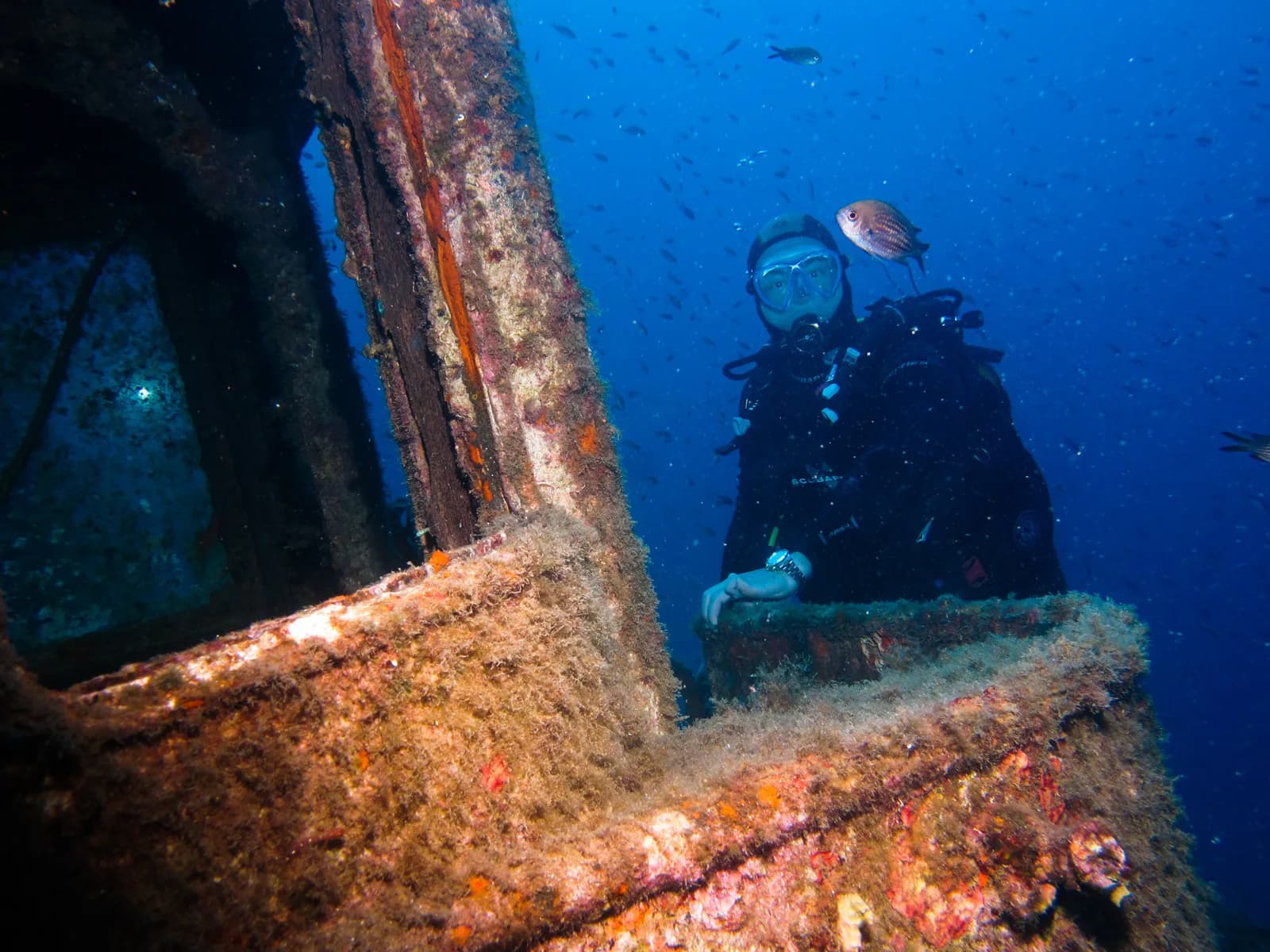
The centrepiece of Le Prophète is its large transmission wheel and massive steam boiler, which dominate the midsection of the wreck. This impressive machinery, around 5 meters in diameter, creates a unique swim-through environment. Moray eels (Muraena helena) and conger eels (Conger conger) are commonly found weaving through the spokes and within the nooks of the boiler and surrounding plates, using these structures as their primary hunting and resting ground.
Beyond the central machinery, the wreck provides habitat for a variety of benthic and pelagic species. Octopus (Octopus vulgaris) are often seen camouflaged among the structure, while schools of fish (unspecified) often shelter in the larger sections of the hull. The stern reveals the steering mechanism, still visible after more than a century and a half underwater, a testament to the ship's construction and an interesting feature for those who appreciate maritime history.
The cargo of Le Prophète, which included crockery and bovine bones, can still be found amongst the twisted metal plates in some sections of the wreck. These remnants offer a glimpse into the ship's final journey and create a rich, varied habitat. Groupers (Epinephelus marginatus) often patrol the edges of the wreck, and you might spot other species like lobster among the less disturbed sections.
Visibility at Le Prophète is generally good, allowing for appreciation of the wreck's scale and detail. The site's photogenic quality comes from the interplay of light and shadow on the well-preserved structures, especially the massive paddle wheel and the propeller. These elements, combined with the resident marine life, provide ample opportunities for photography and closer observation of the wreck's distinct features.
While often calm, this site can experience strong currents, particularly during tidal changes. When a current picks up, it typically flows from the east on the ascent, requiring divers to be mindful of their position throughout the dive profile. Maintaining neutral buoyancy and understanding your gas consumption remains crucial, especially when exploring the more intricate parts of the wreck against a flow.
Le Prophète represents a unique opportunity to explore one of the oldest steamship wrecks in the region. Its detailed structures, such as the propeller and the impressive central machinery, distinguish it from other local dive sites. The combination of historical significance and thriving marine life within a relatively intact framework makes this wreck a rewarding dive, particularly for those interested in maritime archaeology and underwater photography.
This site is accessible to divers with an Advanced Open Water certification or equivalent, and a minimum of 50 logged dives is recommended due to potential current variations and the depth. The dive depth ranges from 28 meters at the highest points to a maximum of 34 meters on the seabed. While current is usually mild, it can become strong, especially during tidal shifts or specific weather conditions. Visibility is generally good. The best period for diving Le Prophète is between April and October, with September offering particularly stable conditions for diving in the region.