
Plongee Tek Marseille
Google 5/5 (429 reviews)
4.7 km away as the crow flies
Marseille · France · Mediterranean
Max. depth · 36 mExplore the remains of a 1903 French passenger ship resting at the base of the Maïre island cliffs.
For subtitles in English: start the video firstthen click the gearat the top right of the video, select “Subtitles/CC”, then “Auto-translate” and choose “English”.
The wreck of Le Liban lies at the foot of the southern face of Maïre island, positioned near the Pharillons. This French ocean liner, which sank following a collision in 1903, remains a significant landmark in the Marseille maritime area. The structure is not entirely flat on the seabed; instead, it rises approximately 5 to 8 metres above the bottom, providing a distinct profile for divers to follow. The ship’s position is fixed against the underwater topography, making it a reliable and recognizable site for those navigating the local waters.
As you descend toward the wreck, the profile of the vessel becomes clear through the water column. The bow of the ship is firmly embedded into the rocky substrate at a depth of approximately 32 metres. Moving along the structure toward the stern, the depth increases steadily. The poop deck represents the deepest part of the wreck, reaching depths of about 36 metres. This gradual slope allows you to manage your buoyancy and descent profile while systematically exploring the different sections of the hull.
The wreck's condition allows for a detailed examination of its various components, making it an excellent site for those interested in maritime history. Because the ship sits upright and relatively well-preserved, you can trace the lines of the hull and identify the different compartments. The way the vessel is integrated into the seabed creates various nooks and crannies that have become part of the local ecosystem. This combination of man-made structure and natural rock creates a complex environment for both navigation and observation.
The surrounding environment is heavily influenced by the southern face of the island, providing a stable backdrop for the wreck. While the ship is the primary focus, the nearby rocks and reef structures contribute to the overall complexity of the site. The proximity to the island means the wreck is situated in a location where the seabed transitions from hard rock to the debris field of the ship. This transition provides different habitats for various species that utilize both the wreck and the adjacent seafloor.
Marine life at Le Liban is well-established within the structure and the surrounding rocky areas. You will frequently encounter various species of seabream and white seabream patrolling the perimeter of the wreck. Larger predators, such as common dentex, are known to move through the area, often drawn to the shelter provided by the ship's mass. The presence of larger fish like grouper and tuna adds to the dynamic nature of the site, especially when they cruise along the edges of the wreck.
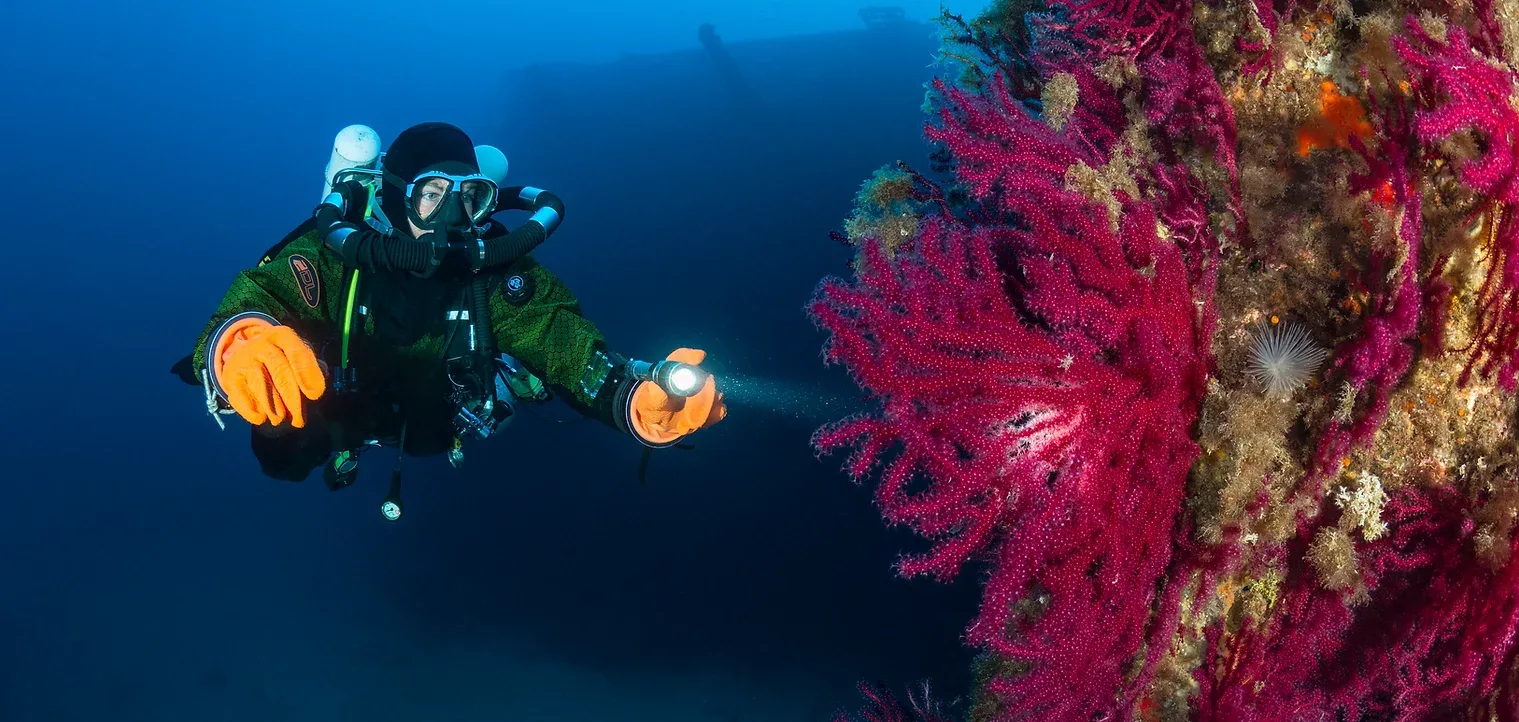
Smaller, more stationary life forms inhabit the crevices and the surfaces of the ship itself. Spiny lobster and octopus find refuge within the structure, often hiding in the shadows of the hull or among the rocks where the bow is embedded. You can also find moray eels and conger eels patrolling the gaps in the debris. The presence of gorgonian corals on the structure and nearby rocks indicates a stable environment where slower-growing organisms can thrive over time.
The visual experience of the site is often defined by the clarity of the water and the way light interacts with the wreck. Depending on the conditions, visibility can range from 10 to 30 metres, allowing for clear views of the ship's silhouette from a distance. When the visibility is high, the scale of the vessel becomes much more apparent as you approach. This clarity is essential for navigating the deeper sections of the wreck, such as the stern, where you must maintain awareness of your surroundings and the bottom contour.
The dive depth ranges from 28 to 36 metres. This site requires an Advanced level, or a Level 2 certification, though a Level 1 diver with a PE40 qualification may be suitable. Expect visibility between 10 and 30 metres. While currents are generally minimal, access is highly dependent on wind conditions; the site is favorable during a Mistral but can become difficult or impractical during east, west, or southwest winds. The best diving season is from May to October.
The best diving season for Le Liban is from May to October. Access depends strongly on the wind: conditions are favorable during a Mistral, while east, west, or southwest winds can make the site difficult or impractical. Visibility may range from 10 to 30 metres, depending on conditions.
Le Liban requires an Advanced level or a Level 2 certification. A Level 1 diver with a PE40 qualification may also be suitable. The wreck lies in deep water, so you should be prepared to manage your descent, buoyancy, and exploration along its different sections.
Le Liban ranges from 28 to 36 metres deep. The bow is embedded in rocks at approximately 32 metres, while the stern reaches about 36 metres. Currents are generally minimal, but wind affects access significantly, with east, west, or southwest winds potentially making the dive difficult or impractical.
At Le Liban, you can explore the upright, relatively well-preserved wreck of a French passenger ship that sank in 1903. Common dentex, tuna, seabream, grouper, spiny lobster, octopus, moray eels, conger eels, and gorgonian corals inhabit the wreck and surrounding rocks, with the ship rising 5 to 8 metres above the bottom.