
Plongee Tek Marseille
Google 5/5 (429 reviews)
12 km away as the crow flies
Marseille · France · Mediterranean
Max. depth · 33 mLe Dalton wreck offers a split-level dive, with its bow in shallower water suitable for Open Water divers and its deeper stern and propeller section reserved for those qualified to 40 metres.
Le Dalton lies spread across the seabed at the foot of Île du Planier, a cargo wreck that broke apart upon impact, now covering an area of roughly 160 square metres. The dive begins near the island's mooring, descending onto the remnants of the bow section, which rests in shallower water on collapsed rock. As you follow the scattered wreckage, the structure gradually leads deeper, revealing more defined features further along the site.
The topography of Le Dalton is defined by its dislocated state, meaning you'll navigate a series of broken sections rather than an intact vessel. This creates numerous smaller habitats for marine life. While much of the wreck is heavily fragmented, the stern section, including the propeller and rudder, remains the most distinct and offers clear points of interest for exploration.
Exploring the deeper areas requires careful navigation, particularly around the stern and propeller, where parts of the wreck can be followed into slightly more confined spaces. It's here you'll find yellow solitary coral (Leptopsammia pruvoti) dotting the structure, adding a splash of colour to the metal wreckage. Conger eels (Conger conger) and moray eels (Muraena helena) are often found sheltering within the larger openings, blending into the shadows.
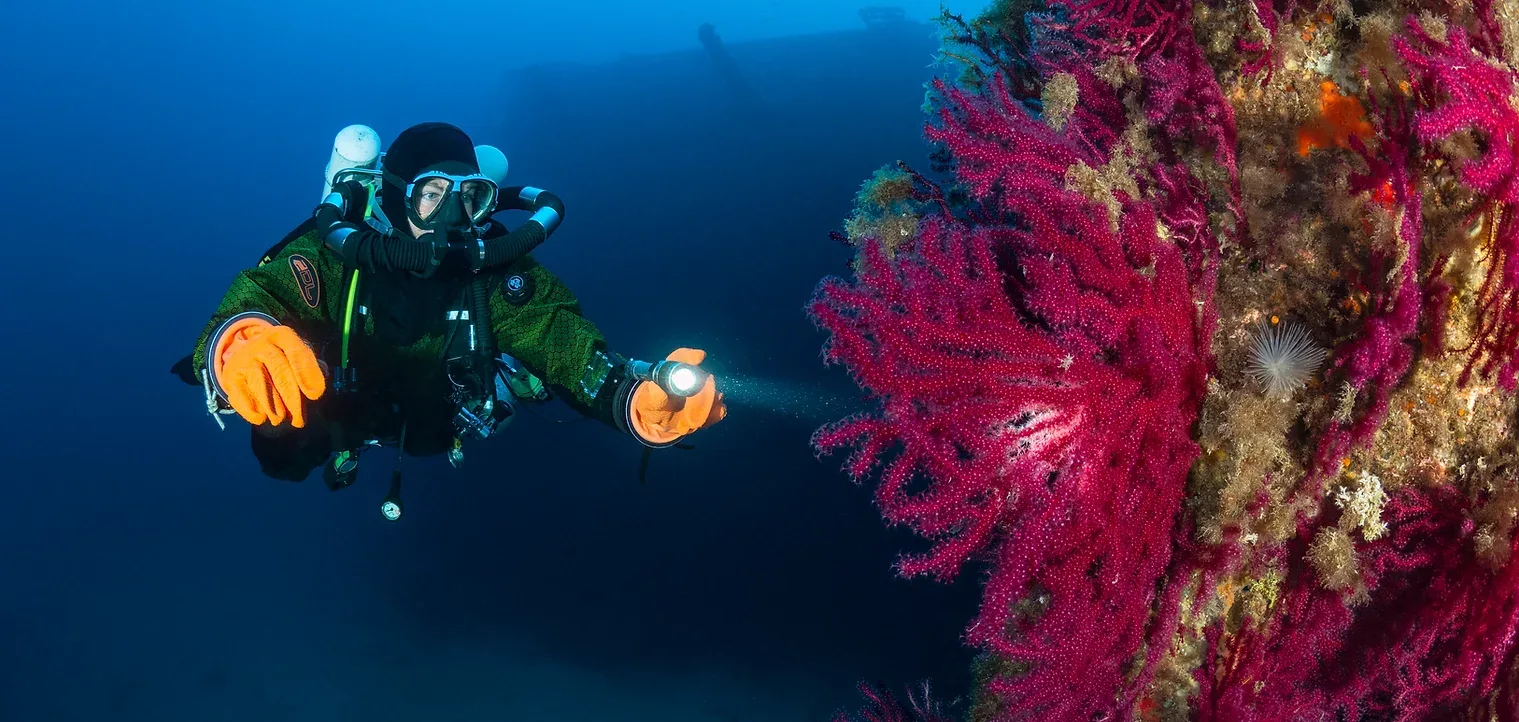
The interaction between the wreck structure and the surrounding rocky seabed provides a varied environment for a range of Mediterranean species. Look for schools of castagnoles (Chromis chromis) and sardines (Sardina pilchardus) shimmering above the wreck, often attracting sars (Diplodus sargus) and brown meagre (Sciaena umbra) that patrol the edges of the wreckage. Gorgonian sea fans (Gorgonia sp.) and patches of red coral (Corallium rubrum) have begun to colonise parts of the wreck, particularly where current brings nutrients.
Around the propeller and rudder, the site comes alive with activity. This area often hosts larger groupers (Epinephelus marginatus) taking shelter, while smaller scorpionfish (Scorpaena scrofa) and forkbeard (Phycis phycis) can be found camouflaged against the seabed and debris. The mix of open water, structural refuge, and vibrant soft corals makes this section a focal point for the dive.
Visibility at Le Dalton is typically good, often ranging between 20 and 30 metres, providing clear views of the entire wreck footprint. However, conditions on the surface, particularly the mistral wind, can significantly impact the site. A strong mistral can generate dangerous surge, making entry and exit from the water challenging or even impossible, so selecting a calm weather window is essential.
The wreck's accessibility to different certification levels is a key characteristic. Open Water divers can explore the shallower sections of the bow, enjoying the initial descent and observing the marine life that congregates there. For Advanced Open Water divers or those qualified to 40 metres, the deeper stern, propeller, and rudder offer more intricate exploration and reveal the full extent of the wreck's structure and resident fauna.
While currents are generally manageable, they can be variable, particularly around Île du Planier. Always be prepared for shifts in water movement, especially when navigating around the more exposed parts of the wreck. Planning your dive to account for potential changes in current ensures a safer and more comfortable exploration of both the shallower and deeper sections of Le Dalton.
The Le Dalton wreck offers a split depth profile, ranging from a minimum of 15 metres on the bow to a maximum of 33 metres at the stern. The upper sections are accessible to Open Water divers with experience on deeper wrecks, while the deeper stern and propeller area requires Advanced Open Water or 40-metre qualified certification. Current at the site is variable and can be influenced by wind and sea state; the dive is only feasible in calm seas and light winds, as mistral conditions can create dangerous surge. Visibility typically ranges between 20 and 30 metres. The best conditions for diving are generally found from June to August, extending into September for the warmest and clearest water.
Le Dalton is generally best from June through August, with September offering the warmest and clearest water. Choose a calm weather window with light winds, because mistral conditions can create dangerous surge and make entering or leaving the water challenging or impossible. Surface conditions strongly influence whether the dive is feasible.
Open Water divers with experience on deeper wrecks can explore the shallower bow section of Le Dalton. The deeper stern, propeller, and rudder require Advanced Open Water certification or qualification to 40 metres. The wreck is broken into scattered sections, so deeper exploration also calls for careful navigation around more confined areas.
Le Dalton has a split depth profile. The bow rests at 15 metres, while the stern and propeller reach 33 metres. You can begin in the shallower bow area and follow the scattered wreckage toward deeper, more defined features. The deeper stern section offers the propeller and rudder, with yellow solitary coral on the structure.
Currents at Le Dalton are generally manageable but variable, especially around Île du Planier, and wind and sea state can change water movement. On the wreck, you may see conger and moray eels, groupers, sardines, castagnoles, sars, brown meagre, scorpionfish, forkbeard, gorgonian sea fans, red coral, and yellow solitary coral.