Liveaboards · Indonesia
Eliya — a purpose-built wooden dive phinisi for Komodo
What makes this boat unique
- Eliya carries up to 14 guests in six air-conditioned ensuite cabins on a Northern and Central Komodo loop from Labuan Bajo.
- Two Yamaha F50 tenders take divers to the sites, while two Bauer compressors and a membrane system support the diving operation.
- Full days aim for four dives: three in daylight and one sunset or night dive, depending on the location.
- The boat combines traditional phinisi construction with a shaded dive deck, camera rinse area, charging stations and several outdoor spaces.
For subtitles in English: start the video firstthen click the gearat the top right of the video, select “Subtitles/CC”, then “Auto-translate” and choose “English”.
The invitation
Eliya is for divers who want Komodo to remain the main event. The boat was built as a dive vessel rather than adapted from a passenger boat, so the useful spaces are where they matter: gear stays on a proper dive deck, cameras have their own rinse area, and two tenders keep the group moving between the boat and the sites. Between dives, the upper sundeck and open-air dining areas give everyone room to come up for air. Six days and five nights is a compact way to work through the Northern and Central Komodo route without turning the trip into a floating hotel stay. The appeal is straightforward: a small group, a crew close at hand, and a boat designed around getting divers into the water repeatedly.
Boarding
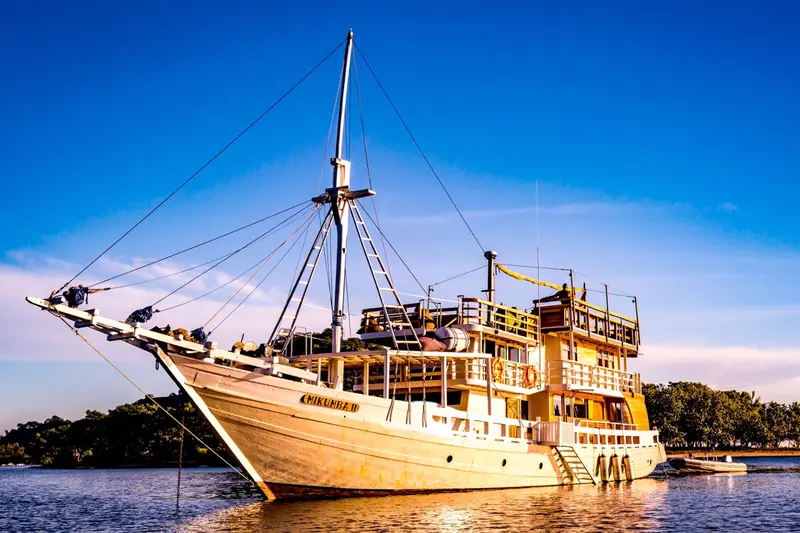
From the dock, Eliya presents the familiar high-sided shape of an Indonesian phinisi, with traditional wooden boatbuilding carried into a modern dive platform. The hull was handcrafted from the keel up by Sulawesi boat builders, then fitted with air-conditioned cabins, private bathrooms and the safety systems expected on a working liveaboard. Once aboard, the layout is easy to read: cabins sit off the main saloon, dining and social spaces occupy the main deck, and the upper levels open into sun and shade. The boat is made for 14 guests, but the crew numbers eight, keeping help close when tanks, cameras or wet gear need moving. It feels less like a resort and more like a purpose-built wooden vessel that has taken the diver seriously.
The atmosphere on board
Eliya takes a maximum of 14 guests with a crew of eight, a close working ratio that shows up in the practical parts of the day. The crew handles the repeated cycle of moving gear, preparing tanks and getting divers back on schedule while the guides focus on the briefings and the water. English, Swedish and Indonesian are spoken onboard. In the evening, guests come together in the covered stern seating, at the alfresco table or on the upper deck, with the bar nearby and the day's sightings still fresh. The atmosphere is social without needing a formal programme: divers have just shared several hours underwater, and the boat gives them the space to compare what they saw before the next early start.
The sites you’ll dive
The recorded itinerary is a six-day, five-night Northern and Central Komodo route, starting and ending in Labuan Bajo. No verified site descriptions are available here, so the page does not attach names, depths or promised encounters to individual dives. What can be said is how the route is built to work: full days aim for four dives, with three daylight dives followed by a sunset or night dive when the location permits. The dive team chooses the sites around conditions and the needs of the group rather than treating a fixed list as more important than the water on the day. That suits Komodo, where currents and conditions are part of the diving rather than background detail.
Itineraries, dates and prices
Prices per person. Each month shows its lowest price: click a month, or pick an itinerary.
Next departures · 15 departuresfrom £1,342$1,794€1,603
April 2027
May 2027
June 2027
See dates and prices
If you click these links and make a purchase on the partner site, DivingDeal may earn a commission, at no extra cost to you.
Dates and prices taken from liveaboard.com, updated 23 October 2026
Who puts you in the water
The dive team gives the briefings onboard before each dive and keeps groups small, with a maximum of four certified divers per guide. Dive staff are trained in EFR and CPR, and oxygen and first-aid kits are carried for emergencies. Eliya also has life rafts, fire protection, VHF and satellite communications, GPS, AIS and other navigation and safety equipment. The crew speaks English, Swedish and Indonesian. Courses run onboard include PADI Open Water, Advanced Open Water, refresher training and several specialties, including Deep, Drift, underwater photography and enriched air nitrox. The Open Water course is intensive: theory is completed before boarding, while the practical training takes place during the first two days. Komodo conditions can be challenging, so confidence in open water matters.
The dive deck and the gear
The dive deck is shaded and arranged for repeated diving, with a proper entry platform, camera stations, charging points and a separate rinse area for cameras. Divers reach the sites in two purpose-built Yamaha F50 tenders, boarding them from Eliya by the collapsible side ladder; the guests are split between both boats rather than packed into one. Tanks are prepared onboard by two Bauer compressors. A membrane system makes nitrox available, but nitrox is an optional upgrade rather than a standard inclusion. DIN adapters are carried, and rental equipment is included in the package. The setup also supports sidemount diving. Microfibre hooded towels are provided for the intervals, which matters when the next dive arrives before wet gear has had much chance to dry.
Between dives
The gaps between dives can be spent under the shaded areas of the dive deck, in the covered seating at the stern, or outside at the bow and on the upper sundeck. The boat also carries stand-up paddleboards and snorkeling equipment for time away from scuba gear. The bow dining area is open to the surroundings, while the stern has covered seating beside the bar. When the boat is moving between sites, these spaces give the trip its surface life without separating guests into isolated corners. There is also an option for land excursions, so a surface interval can mean more than drying equipment and waiting for the next briefing.
A day on board
A full dive day begins around dawn. A briefing comes first, then divers prepare on Eliya before taking one of the two tenders to the site. The aim is three daylight dives, with breakfast after the first, lunch during the longer middle surface interval, and another meal arranged around the final sunset or night dive. Between sites, tanks and equipment are prepared while divers return to shade, dry off and eat. The last dive depends on the location: it may be a sunset dive or a night dive. Once the gear is rinsed and stored, dinner brings the group back together on deck. Then the boat settles into its overnight rhythm, ready to repeat the sequence the following morning.
What you eat aboard
Meals are full board, with buffet service, local and Western cooking, snacks through the day, and options for vegetarian and vegan diets. Dinner is served as three courses every evening, with the choice of eating outdoors when conditions allow. The kitchen follows a no-seafood policy because the operation cannot guarantee that seafood available in Labuan Bajo has been sustainably caught. That leaves the table focused on other local ingredients and familiar Western alternatives rather than pretending every regional dish must contain fish. On a four-dive day, the important point is timing: snacks are available around the first preparations, breakfast follows the opening dive, lunch lands during the longer surface interval, and dinner closes the work of the day.
Nights at sea
The six cabins sit on the main deck: four twin/double cabins and two triple cabins. The double cabins combine a queen-size bed with a single bed, while the triple cabins have three single beds. Each has air-conditioning, a private toilet and shower, a porthole, reading lights, international charging sockets and storage beneath the beds. Spring mattresses, 300-threadcount linen and stitched cushions make the cabins more considered than their compact footprint suggests. The portholes bring in daylight, while reef-friendly shampoo and shower gel are provided in the bathroom. These are cabins for sleeping properly between dives, not for spending the afternoon in. The boat gives the daylight hours to the water and the decks.
Twin/Double Cabins
Triple Cabins
What to know before boarding
Eliya departs from and returns to Labuan Bajo. Transfers from the airport or a hotel are included, with pickup details communicated before embarkation. The operator's office is on the main street in Labuan Bajo, close to the airport. Arriving the night before is the sensible choice, leaving room for flight delays before the boat leaves.
Deck plan
What the boat does for the ocean
Eliya provides drinking water refills instead of plastic water bottles, and reef-friendly biodegradable toiletries are supplied in the cabins. The operation follows a no-seafood policy, runs regular shoreline and underwater clean-ups, and records sightings and environmental data for Marine Megafauna Foundation research through Dive the Data. Dive briefings include buoyancy guidance and manta protocols: divers must not touch, chase or harass animals, and must avoid swimming over cleaning stations. The crew also collects photo-identification images of manta rays when possible, contributing information on individual animals and their movements.
- Year built
- 2022
- Length
- 30 m
- Beam
- 6.4 m
- Maximum number of passengers
- 14
- Number of cabins
- 6
- Number of bathrooms
- 6
- Engines
- Mitsubishi
- Cruising speed
- 5-9 knots
- Tenders
- 2 × Yamaha F50
- Website
- scubajunkieliveaboards.com ↗
Hello, I'm Marina, DivingDeal.com's AI assistant. I answer in detail about hotels, dive centres and liveaboards.
Thinking about the whole trip and the flights? Talk it over with Edith →
Marina is an AI. Some links are affiliate links: DivingDeal may earn a commission, at no extra cost to you. Bookings are made with the partner.