Porquerolles Plongée
Google 4.7/5 (143 reviews)
5.1 km away as the crow flies
Porquerolles · France · Mediterranean
Max. depth · 30 mA conical rock formation rising from the sandy seabed to 14 metres, defined by deep crevices and heavy sponge growth.
For subtitles in English: start the video firstthen click the gearat the top right of the video, select “Subtitles/CC”, then “Auto-translate” and choose “English”.
Le Sec Du Gendarme is a conical rocky rise situated off the Cap des Mèdes, east of Porquerolles. The structure emerges from a vast sandy plain, creating a distinct topographical landmark in the area. Its summit sits between 14 and 16 metres, while the base of the formation drops down to depths of approximately 30 metres. This verticality creates a variety of micro-habitats within a relatively narrow depth range, offering different environments for divers to explore as they descend.
The topography is characterized by a succession of large rock blocks and deep, narrow fissures. These cracks and crevices provide essential shelter for many resident species, making the site interesting for those who enjoy searching through structures. As you move around the pinnacle, the terrain shifts from the relatively flat summit to more rugged, broken sections near the base. This uneven layout means that even a short dive can provide a significant change in scenery and biological density.
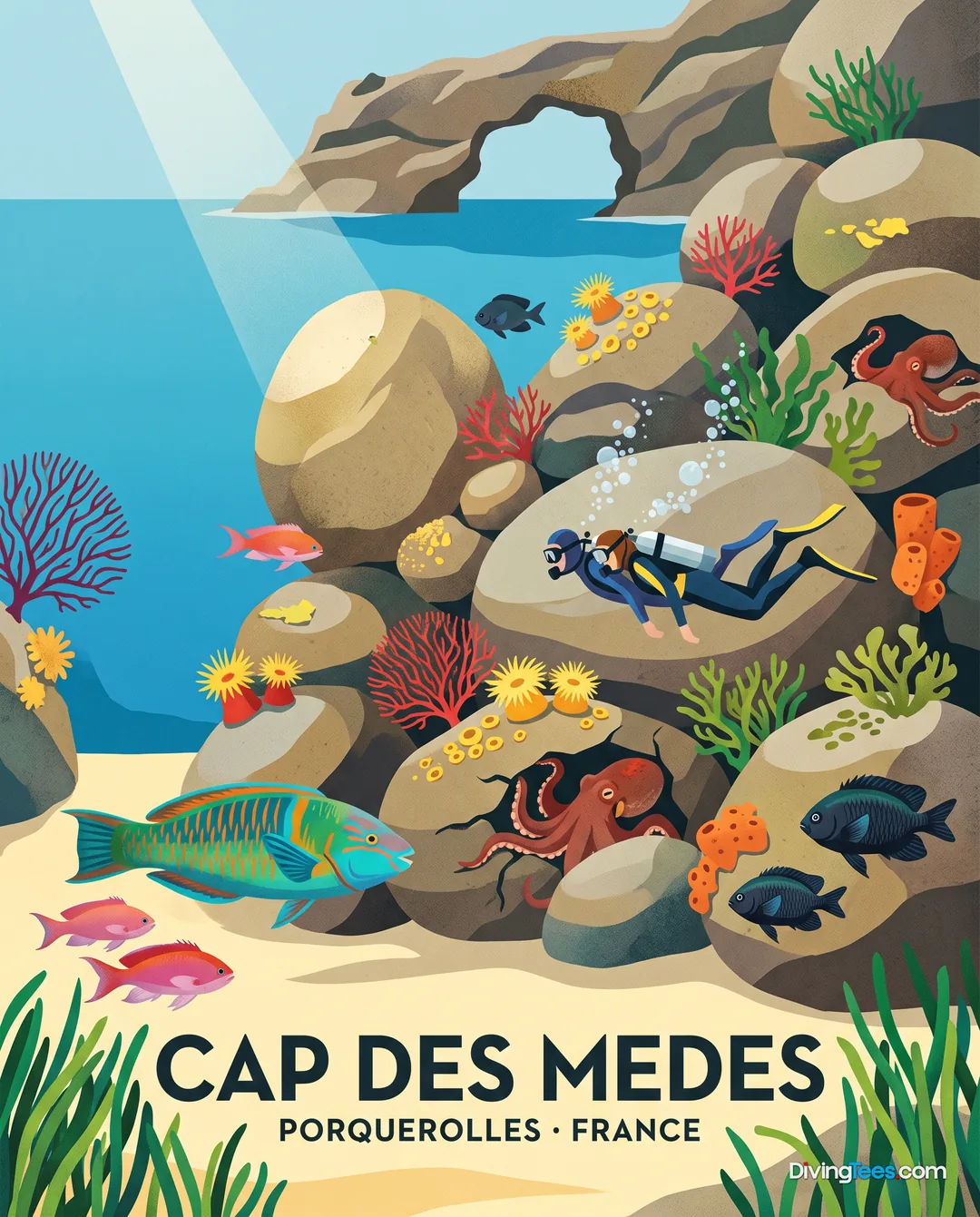
The biological life is heavily concentrated on the rocky surfaces of the pinnacle. You will encounter extensive growth of Axinella polypoides and various gorgonians that cling to the vertical faces. Yellow sponges and various anemones also coat the rock, providing a textured backdrop to the site. These encrusting organisms create a complex surface that supports a diverse community of smaller invertebrates and fish, making the physical structure of the rock as important as the depth itself.
Fish life at Le Sec Du Gendarme is consistent with the high-quality habitats found in this part of the Mediterranean. You can expect to see Mediterranean chromis and Mediterranean rainbow wrasse moving in the lighter depths around the summit. Larger, more sedentary species like the dusky grouper and brown meagre are often found patrolling the deeper cracks or resting near the rock blocks. Moray eels and conger eels frequently inhabit the many crevices, watching the area from the safety of the stone.
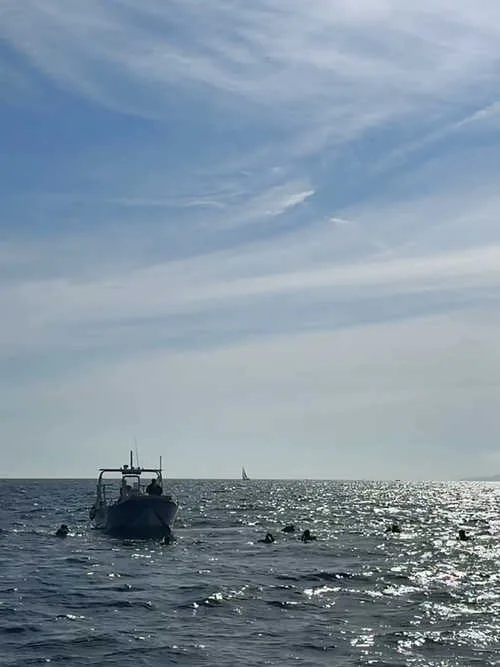
The site's exposure to the elements is a defining characteristic of the diving experience here. Because the pinnacle stands alone in a sandy area, it is highly susceptible to the Mistral wind. When the wind is strong, the site can experience significant currents that affect both the divers and the boat's ability to maintain a steady position. These conditions mean that the site's character can change rapidly, shifting from a calm exploration to a more demanding technical environment.
Navigation on the site is relatively straightforward due to its conical shape, but the surrounding sandy bottom requires attention. The transition from the hard structure of the pinnacle to the soft sand of the seabed is abrupt. It is important to maintain contact with the rocky features to avoid drifting into the open sandy areas during periods of movement. The combination of the vertical relief and the surrounding flat seabed makes the pinnacle easy to locate once you are in the water.
For those observing the smaller details, the European spider crab and various sea urchins can be found among the rocks and within the crevices. Mediterranean cardinalfish often hover near the sheltered parts of the structure, away from the direct force of the water. The presence of white seabream in the mid-water column adds to the constant movement around the rock. Every section of the pinnacle, from the sunlit top to the shaded faults, offers a different perspective on the local marine ecosystem.
Depths range from 14 to 30 metres. While classified as Level 1, the site is exposed to the Mistral and can experience significant currents; an advanced level with experience in exposed conditions is strongly recommended. Best diving occurs during periods of low wind.
Choose Le Sec Du Gendarme during periods of low wind. The pinnacle is exposed to the Mistral, and stronger wind can produce significant currents around the isolated rock rising from the sandy plain. Conditions may change rapidly, so a calm-weather window provides more suitable circumstances for exploring its summit, fissures, and blocks.
Le Sec Du Gendarme is classified as Level One, but its exposure to the Mistral can create significant currents. An advanced level with experience in exposed conditions is strongly recommended. The current may affect both you and the boat, while movement around the pinnacle requires attention to avoid drifting over the surrounding sand.
Le Sec Du Gendarme offers a varied profile from fourteen to thirty metres. The conical summit lies between fourteen and sixteen metres, while the formation descends to approximately thirty metres at its base. This vertical relief lets you move from a relatively flat top to deeper rock blocks and narrow fissures.
At Le Sec Du Gendarme, you can explore large rock blocks and deep fissures covered with Axinella polypoides, gorgonians, yellow sponges, and anemones. Mediterranean chromis, rainbow wrasse, dusky grouper, brown meagre, moray eels, conger eels, spider crabs, sea urchins, cardinalfish, and white seabream also inhabit the structure.