
Tiki Dive
Google 4.9/5 (288 reviews)
28 km away as the crow flies
Cavalaire-sur-Mer · France · Mediterranean
Max. depth · 47 mExplore the historic wreck of the Sagona, a cargo ship sunk in 1945, now a vibrant artificial reef teeming with marine life.
For subtitles in English: start the video firstthen click the gearat the top right of the video, select “Subtitles/CC”, then “Auto-translate” and choose “English”.
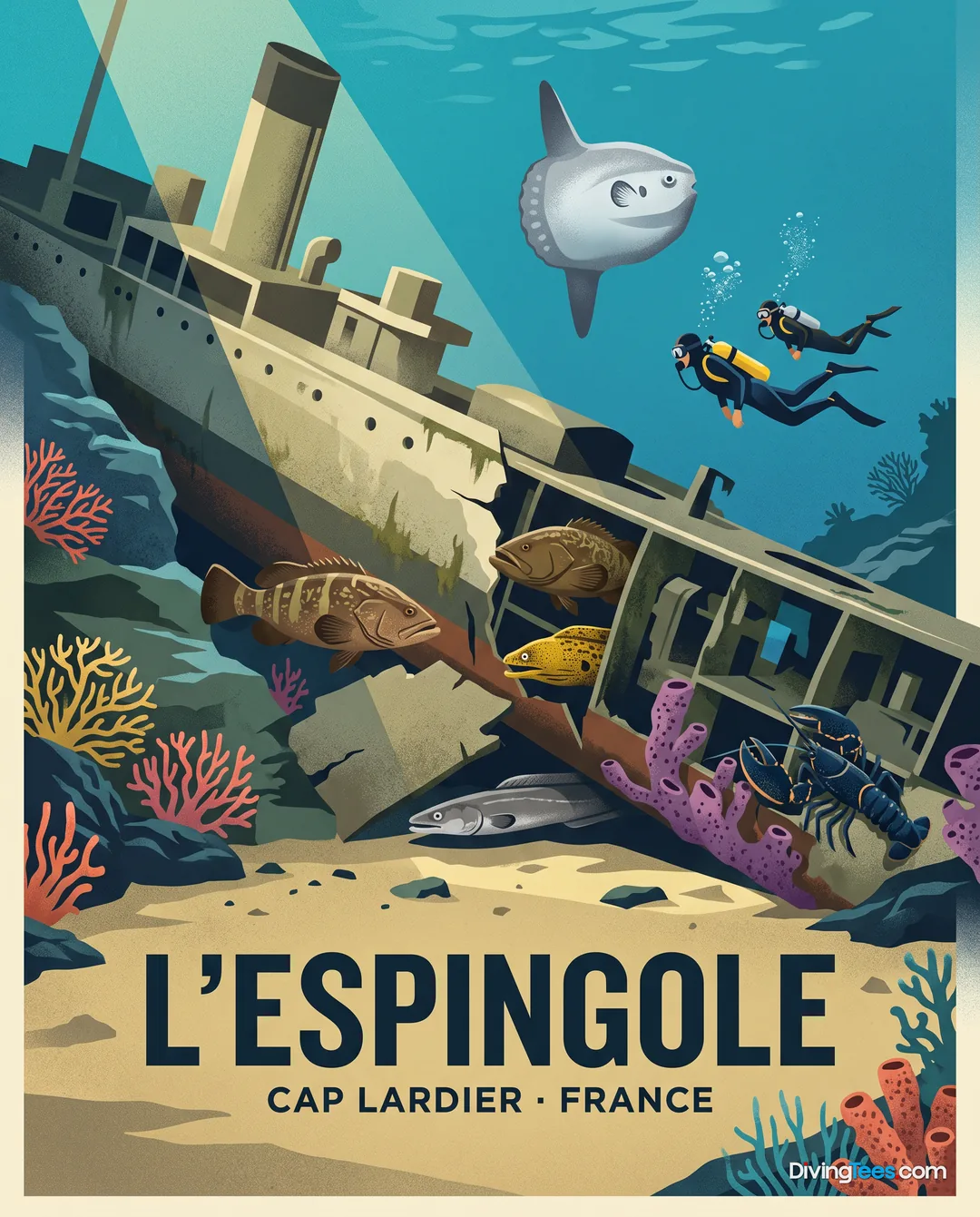
The cargo ship Le Grec, also known as the Sagona, offers a deep dive off the coast of Hyères on a vessel constructed in 1912 and tragically sunk in 1945 by a mine. The wreck rests upright on a sandy bottom, with its deepest point reaching 48 meters. The dive typically starts with its stern section, a substantial piece of maritime history measuring 54 meters in length. You'll descend to the propeller at 47 meters, a prominent starting point for your exploration. From there, you work your way up to the dunette, where an open hatch provides access to portions of the interior, and the massive winch that once managed cargo lines. Moving along the superstructure, its corridors are now vibrant with marine life.
The interior spaces and corridors present an opportunity for penetration, but this requires specific training and equipment, as the environment is silty and complex. Even without entering, the exterior offers ample to explore: the wreck's structure is heavily colonized by gorgonians, creating a colourful tapestry against the steel. These soft corals provide shelter and feeding grounds for a variety of smaller reef fish, making careful observation worthwhile as you navigate the different deck levels.
Continuing your dive towards the bow, you'll encounter a remarkable intact funnel before reaching the break in the hull. This split in the wreck is a result of the mine strike that sent the Sagona to the seabed in 1945. The separation between the stern you've just explored and the bow section extends for 60 to 80 meters, demanding careful navigation and good air management to visit both parts on a single dive, especially given the depth.
The bow section sits at the same depth as the stern, reaching 47 meters, with its mast clearly visible, lying towards the port side. While less complex than the stern's superstructure, the bow still offers good points of interest. You'll observe less superstructure here, but the exposed plating and framework provide ample surface for further gorgonian growth, and crevices that attract various reef species. This separate topography essentially offers two distinct dive profiles within one site.
Marine life on Le Grec is diverse, with gorgonians dominating the wreck's surfaces. Look for anthias (sea goldie) schooling above the wreck, and castagnoles (damselfish) darting in and out of openings. Bogues (bogue) and mérous (groupers) can be found seeking shelter in deeper cracks and more confined spaces. Smaller species like rougets (red mullets) and rascasses (scorpionfish) are often camouflaged against the encrusted metal. The wreck also hosts congres (conger eels) and murènes (moray eels) which inhabit the darker recesses and larger openings within the ship's structure. These larger predators are often shy but can be observed with a patient approach. The overall biological density on the Sagona is notable, transforming a steel hulk into a living reef, which is a characteristic of older wrecks in the Mediterranean.
Le Grec is located adjacent to the Donator wreck, both having sunk around the same time. This proximity implies a shared geological and hydrographic environment, including exposure to similar current patterns. Being side-by-side, they form a significant underwater landmark, drawing similar marine fauna and offering a consistent dive experience in terms of site conditions and biological interactions within their respective ecosystems.
The dive depth on Le Grec ranges from 35 meters to 48 meters, with the propeller at 47 meters. A minimum of CMAS **, Level 2, or an equivalent advanced diving qualification is required, and prior experience with wreck diving is strongly recommended due to the depth and potential for penetration. Currents at the site are variable, often encountered as strong, which may necessitate a drift decompression. While specific strong currents are not consistently reported, local effects can occur. Visibility is generally good, however, careful gas planning and decompression management appropriate for deep diving are essential when diving to 48 metres.
You need a minimum CMAS **, Level 2, or an equivalent advanced diving qualification for Le Grec. Previous wreck-diving experience is strongly recommended because the site is deep and may involve penetration. Entering the interior also requires specific training and equipment, as the corridors are silty and complex.
Le Grec ranges from 35 to 48 metres, with the propeller at 47 metres. The wreck rests upright on a sandy bottom, and both the stern and bow reach about 47 metres. Diving these depths requires careful gas planning and decompression management appropriate for deep diving.
Currents at Le Grec are variable and are often strong. Local effects can occur, and conditions may require a drift decompression. You should plan carefully for the current, the wreck’s depth, and the distance between its two sections, while allowing for appropriate gas management throughout the dive.
You can explore a historic cargo-ship wreck divided into stern and bow sections, with a chimney, propeller, mast, corridors, superstructure, and gorgonian-covered surfaces. Marine life includes anthias, castagnoles, bogues, mérous, rougets, rascasses, congres, and murènes. You may also encounter the wreck’s open hatch and cargo winch.