CMAS
Cap Camarat Plongee
Google 4.9/5 (286 reviews)
3.2 km away as the crow flies
Ramatuelle · France · Mediterranean
Max. depth · 60 mDescend on the La Poursuivante, a historic torpedo boat resting in two distinct sections on the seabed off Ramatuelle.
For subtitles in English: start the video firstthen click the gearat the top right of the video, select “Subtitles/CC”, then “Auto-translate” and choose “English”.
La Poursuivante is a torpedo boat, originally 80.7 metres long and displacing 630 tonnes. It was intentionally sunk on January 31, 1958, to serve as an underwater target, after a history that saw it launched in 1936, scuttled in Toulon in 1942, refloated in 1943, and finally sinking definitively in 1947 during a towing operation. This history shapes the present state of the wreck: a substantial vessel now lying in two distinct parts on the sand.
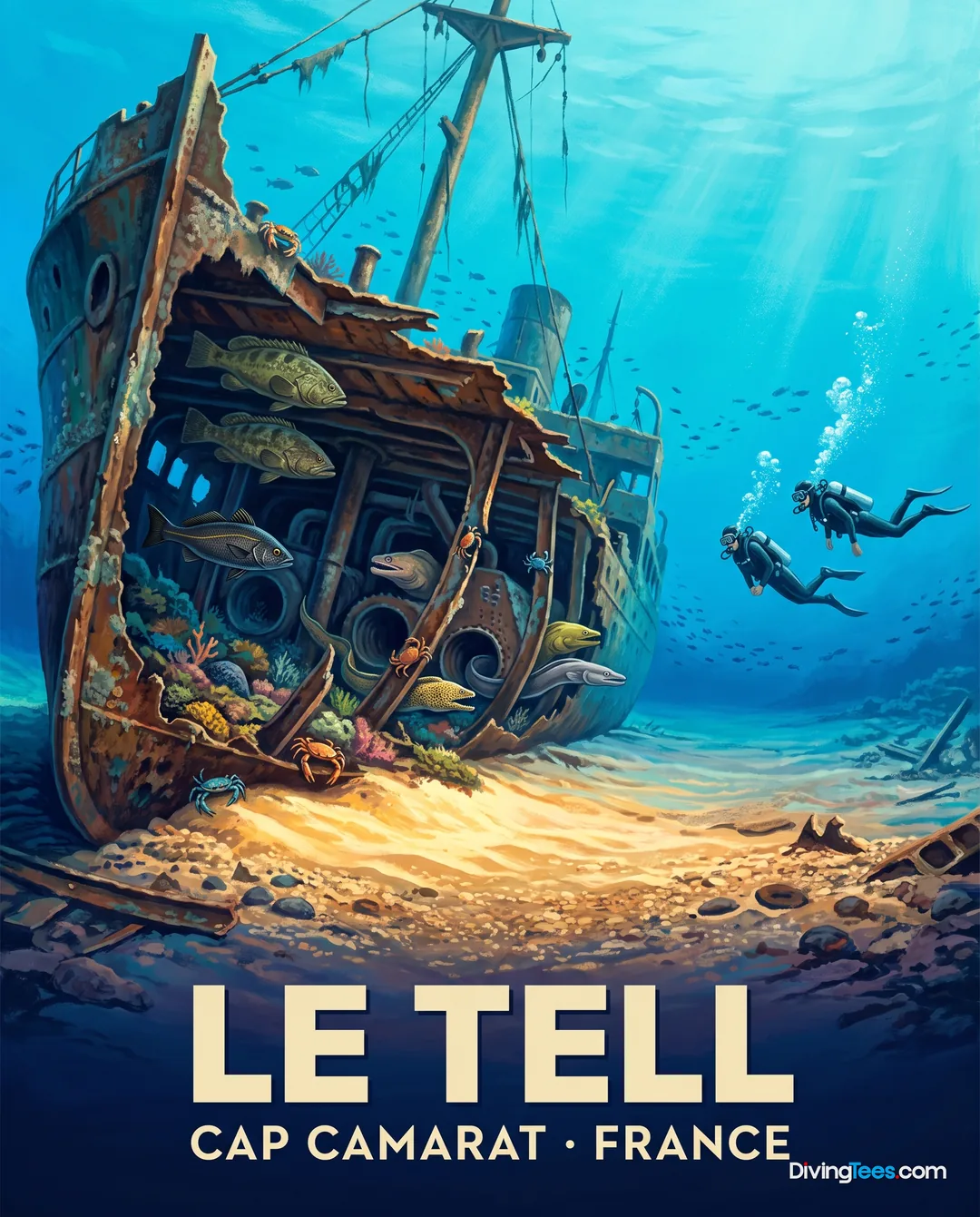
The wreck lies broken in two sections, touching but separated by the forces of its sinking. The stern section, including the rudder and propeller housing, rests inclined on its side, while the bow section is inverted, keel-up. This orientation presents different perspectives on the vessel's structure, allowing divers to explore both the upright and overturned aspects of what was once a unified warship. Your descent takes you past these differing sections, each revealing different angles of her past.
The maximum depth on the La Poursuivante reaches 60 metres, specifically around the propeller shafts of the stern section, but the primary dive profile for much of the exploration is maintained around 55 metres. This places the site firmly in the realm of deep diving. Navigating between the two large pieces of the wreck requires attention to your depth and gas management, particularly when tracing the length of the hull sections.
Despite its depth, the wreck attracts a variety of marine life. You can expect to encounter robust species such as conger eels (Conger conger) and moray eels, often found sheltering within the twisted metalwork and beneath overturned plates. Larger crustaceans, including lobsters, are also residents here, making use of the structure for protection. Tacaud and groupers (Epinephelus marginatus) are also observed patrolling the wreck, adding movement to the solemn structure.
This is an advanced dive due to the depths involved, with the shallowest part of the wreck at 45 metres and the deepest at 60 metres. Divers should hold an advanced certification and have relevant deep diving experience; a minimum of 50 logged dives is a practical reference to safely manage the depth and bottom time. Since this dive is relatively deep, proper gas planning and decompression considerations are essential for safe exploration.
La Poursuivante is a deep wreck dive ranging from 45 to 60 metres. Much of the exploration takes place around 55 metres, while the greatest depth is near the stern’s propeller shafts. The wreck’s shallowest areas are still at 45 metres, so the entire site requires careful depth and gas management.
La Poursuivante is suitable for advanced divers because of its depth. You should hold advanced certification and have relevant deep-diving experience. A practical reference is at least 50 logged dives, helping you manage the depth and bottom time. Proper gas planning and decompression considerations are essential for this exploration.
La Poursuivante is a torpedo boat lying in two large sections on the sand. The stern, with its rudder and propeller housing, rests inclined on its side. The bow is inverted, keel-up. The sections touch but remain separated, giving you different perspectives on the vessel’s structure during the dive.
At La Poursuivante, you can look for conger eels and moray eels sheltering in the twisted metalwork and beneath overturned plates. Lobsters use the wreck for protection, while groupers and tacaud patrol the structure. These animals inhabit or move around the two wreck sections, adding life to the remains.